



Undergraduates on the Frontier of Intelligence Research
At the Kempner Institute, Harvard students are learning to be world-class scientists, and making discoveries about the very nature of intelligence
Harvard undergraduates at the Kempner are doing hands‑on research at the frontier of natural and artificial intelligence. From probing how the brain learns to building next‑generation AI systems, students work closely with leading faculty and undertake research using one of the largest academic computing clusters in the world.
Making the leap from curious undergraduate student to bona fide scientist requires learning how to ask the right questions, and access to the tools and techniques necessary to find answers.
But more than that, it requires the mentorship of experienced researches, who can collaborate, nudge, and guide budding scientists in the right direction.
In a new video, we show how the Kempner Institute is doing just that, training the next generation of scientists to make fundamental discoveries at the the intersection of AI and natural intelligence.

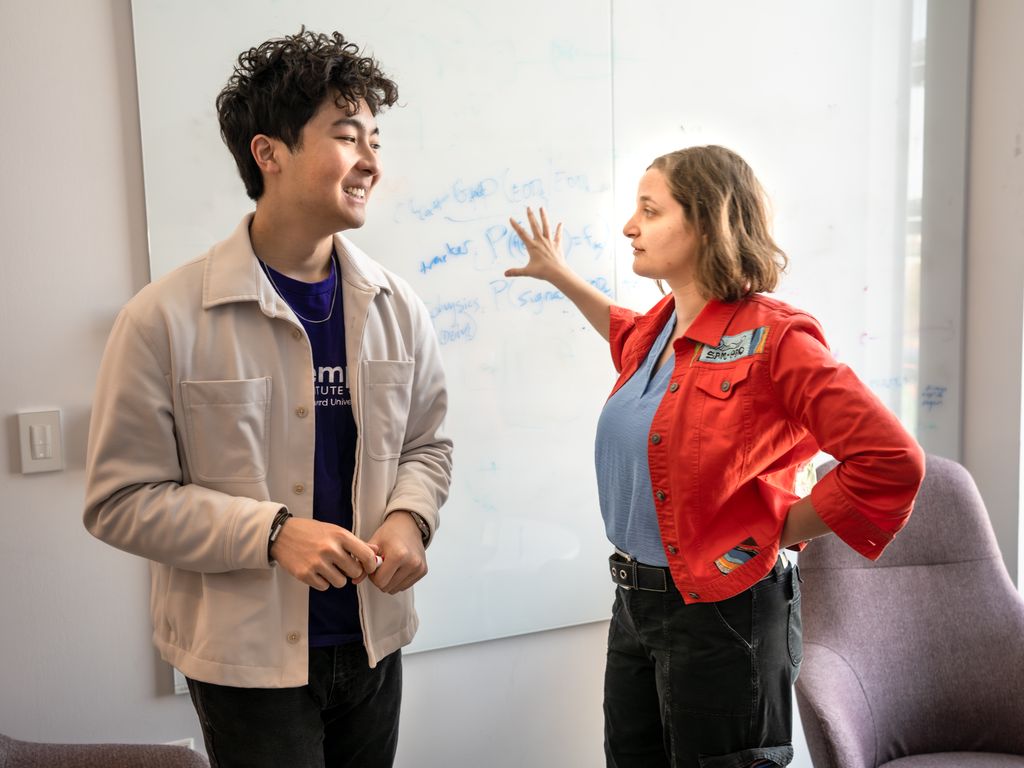

“We have one of the largest academic computational clusters in the United States,” explains Kempner Executive Director Elise Porter. “That’s helpful. It’s helpful to have that tool. But if you don’t have a partner to teach you to use that tool effectively, it’s wasted.”
“That’s what the students get here,” she says. “They get the support to pursue these ideas with the right resources. It’s not just unusual. It’s what makes it happen.”
To date, the Kempner’s undergraduate research programs, which were launched in the spring of 2024, have supported more than 70 undergraduate research projects. Many participants have gone on to pursue graduate-level research, including three students awarded Rhodes Scholarships to undertake graduate research at Oxford University.
Watch the video
About the Kempner
The Kempner Institute seeks to understand the basis of intelligence in natural and artificial systems by recruiting and training future generations of researchers to study intelligence from biological, cognitive, engineering, and computational perspectives. Its bold premise is that the fields of natural and artificial intelligence are intimately interconnected; the next generation of artificial intelligence (AI) will require the same principles that our brains use for fast, flexible natural reasoning, and understanding how our brains compute and reason can be elucidated by theories developed for AI. Join the Kempner mailing list to learn more, and to receive updates and news.