

Kempner Institute Announces Newest Accelerator Award Recipients
Four projects led by Harvard faculty members selected for grant program supporting advanced computational research in intelligence
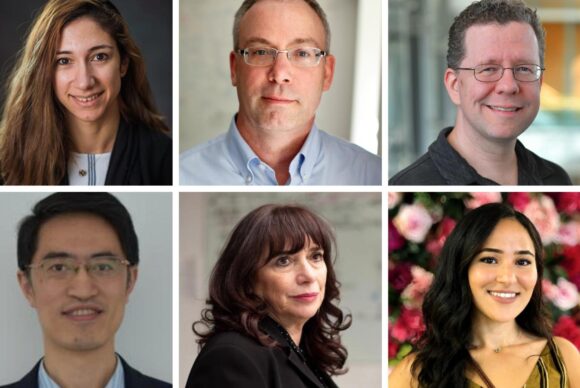
This year’s awards will support four computational research projects led by a total of six principal investigators, clockwise from top left: Maha Farhat, Wade Harper and Edward Huttlin, Noor Youssef and Debora Marks, and Samuel Kou.
The Kempner Institute for the Study of Natural and Artificial Intelligence at Harvard University is pleased to announce the recipients of the 2026 Kempner Institute Accelerator Awards, a grant program for Harvard faculty researching intelligence.
This year’s awards will support four computational research projects led by a total of six principal investigators: Maha Farhat, Wade Harper and Edward Huttlin, Samuel Kou, and Debora Marks and Noor Youssef.
The accelerator awards provide in-kind support to Harvard faculty undertaking advanced computational research projects that are aligned with the Kempner’s mission, and that require computing resources at a scale that is typically unavailable to Harvard faculty. Accelerator award recipients pursue their projects using the Kempner AI Cluster, one of the largest and most powerful academic AI clusters in the world.
The 2026 accelerator award projects commenced in June 2026, and research will continue through March 2027.
About the awardees and their projects
Maha Farhat: Building Generalizable ML-based Workflows for Antibiotics Discovery
Maha Farhat, Gil Omenn Associate Professor of Biomedical Informatics at Harvard Medical School, will use the accelerator award to develop new tools that generate antibiotics targeting tuberculosis, the world’s leading infectious-disease killer.
Farhat’s lab will leverage the Kempner AI Cluster to develop a platform that designs new antibiotic candidate molecules of interest and predicts their mechanism of action (MoAs), offering a way to reduce the costly wet-lab trial and error process typically used to identify molecules of interest.
The project will develop a three-stage, closed-loop AI platform that will 1) scale an AI model that uses molecular structure and genotype to predict whole-cell inhibition; 2) plug this signal into an existing diffusion model already used to make tens of thousands of anti‑TB candidates to create new molecules that specifically target an essential and well-characterized tuberculosis cell-wall enzyme called DprE1; and 3) Use an existing diffusion model fine-tuned to tuberculosis to predict protein‑ligand complexes; compare those complexes to known DprE1 binders; and use the scores to re‑rank or regenerate antibiotic candidate molecules.
“This would be the first generative framework combining large-scale gene-chemical interaction data with online structural validation to target any gene product of interest — an in silico MoA screening platform intended to cut the time and cost of antibiotic development.”
Maha Farhat, Gil Omenn Associate Professor of Biomedical Informatics at Harvard Medical School
Wade Harper and Edward Huttlin: Proteome-scale Structural Modeling of Synaptic Protein Interactions
While brain functions depend on coordinated activity of thousands of synaptic proteins, structural knowledge of how these proteins physically interact remains limited. To address this, Wade Harper, Professor and Department Chair in the Harvard Medical School Department of Cell Biology, and Edward Huttlin, Instructor in the Department of Cell Biology at HMS, will use the accelerator award to create a structural database of synaptic protein interactions in the brain.
This project will leverage advanced AI tools for predicting 3D protein structures (AlphaFold2 and ColabFold), and integrate two major protein interaction resources—SynGO (a consortium cataloguing human synaptic proteins and their functions) and BioPlex (a large database of human protein interactions). Together with the Kempner AI Cluster, these tools will allow the researchers to model tens of thousands of currently unmapped synaptic and synapse-related protein interactions, enabling the creation of a much more complete 3D structural map of human synaptic protein networks.
“The resulting structural database would suggest complex architectures, link interactions to functional domains, and map disease variants onto molecular interfaces — testable hypotheses linking synapse molecular architecture to brain function and disease.”
Wade Harper, Professor and Department Chair in the Harvard Medical School Department of Cell Biology, and Edward Huttlin, Instructor in the Department of Cell Biology at HMS
Samuel Kou: Empowering Generative AI Models for One-to-Many and Distributional Protein Structure Prediction
Samuel Kou, Abbott Lawrence Lowell Professor of Statistics in Harvard’s Faculty of Arts and Sciences, will use the accelerator award to address a gap between typical AI protein structure predictors and the reality of how some proteins actually fold. While most AI structure predictors (e.g., AlphaFold2) assume a one-to-one mapping between sequence and structure, many fold-switching proteins in reality toggle between multiple stable structures. Intrinsically disordered proteins occupy shifting ensembles of unstable conformations.
With the accelerator award, Kou will train a diffusion model built on top of an existing protein structure predictor (AlphaFold2’s Evoformer). Using synthetic ensembles generated with SMICE, his team’s own GPU-accelerated tool, Kou and his team aim to train this converted model from a one-shot protein structure predictor into a fast probabilistic sampler of structural ensembles.
“A generative model that samples the full range of protein conformations at proteome scale would improve fold-switching detection, drug design, and protein engineering.”
Samuel Kou, Abbott Lawrence Lowell Professor of Statistics in Harvard’s Faculty of Arts and Sciences
Debora Marks and Noor Youssef: VirRM, a Viral Foundation Model Across Scales–from a Single Patient to the Global Population
Debora Marks, who is Professor of Systems Biology at Harvard Medical School, and co-principal investigator Noor Youssef, who is Scientific Lead of Predictive Modeling in the Marks Lab, will use the accelerator award to continue their work on VirFM, a virus-aware foundation model with built-in reliability estimates, which was developed under a prior Kempner accelerator award. Using the Kempner AI Cluster, Marks and Youssef will run large-scale evaluations that expose where the model underperforms (guiding further tuning), and then apply VirFM to two new applications.
The work aims to forecast evolution of the 40 WHO-designated high-pandemic-risk viruses, many of which are data-poor, and make all predictions public. It also hopes to predict intrahost viral evolution using a curated longitudinal dataset to anticipate drug-resistance mutations before they emerge.
“Beyond the two direct applications, the work aims to identify general principles for why standard model architectures fail on sparse and diverse biological data — relevant to other low-data domains like antimicrobial resistance and rare genetic disease.”
Debora Marks, Professor of Systems Biology at Harvard Medical School, and Noor Youssef, Scientific Lead of Predictive Modeling in the Marks Lab
About the Kempner
The Kempner Institute seeks to understand the basis of intelligence in natural and artificial systems by recruiting and training future generations of researchers to study intelligence from biological, cognitive, engineering, and computational perspectives. Its bold premise is that the fields of natural and artificial intelligence are intimately interconnected; the next generation of artificial intelligence (AI) will require the same principles that our brains use for fast, flexible natural reasoning, and understanding how our brains compute and reason can be elucidated by theories developed for AI. Join the Kempner mailing list to learn more, and to receive updates and news.