


Kempner Institute Celebrates Research Fellows Naomi Saphra and Alex Damian as They Depart for Faculty Roles
Saphra will join the faculty of Boston University, Damian will join the faculty of MIT
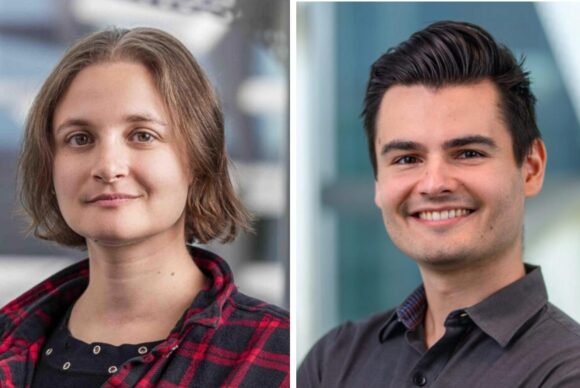
Research Fellows Naomi Saphra (left) and Alex Damian (right) will soon begin new faculty appointments at Boston University and MIT, respectively.
Allston, MA — Research Fellows Naomi Saphra and Alex Damian conclude their fellowships at the Kempner today and will soon begin new faculty appointments at Boston University and MIT, respectively.
Saphra joined the Kempner in 2023 as a member of the inaugural cohort of research fellows and is joining the Faculty of Computing & Data Sciences at Boston University as an assistant professor on July 1.
At the Kempner, Saphra worked on a broad array of projects related to AI and large language models (LLMs), focusing on how models internally represent concepts and other information. She recently contributed to a multi-institution collaboration on Adversarial Concept Search (ACS), which demonstrates that the structure of an LLM’s conceptual representations can be used to predict the types of problems it will struggle to solve.
Saphra’s work on interpretability was featured last year in an article in Quanta magazine. She describes her time at the Kempner as one that provided “a dizzying level of intellectual freedom in research.”
“I had so many exciting projects with so many great collaborators,” she says.
Alex Damian joined the Kempner Institute as a research fellow in 2025. This fall, he will become an assistant professor at the Massachusetts Institute of Technology, where he will have a joint appointment in the Department of Mathematics and the Department of Electrical Engineering and Computer Science.
Damian uses mathematical analysis to uncover principles governing how AI systems learn. His recent work on understanding transformer loss landscapes, co-authored with Kempner collaborators Alex Meterez, Pranav Ajit Nair, Cengiz Pehlevan, and Sham Kakade, is forthcoming. The new research aims to find a simplified model of LLM training dynamics that’s both mathematically tractable and empirically accurate.
Of the work, Damian says, “We managed to estimate the Hessian spectrum of an LLM during training, and the structure we found was surprising enough that it immediately spawned follow-up directions.”
“The Kempner is full of energetic and curious people who are genuinely interested in each other’s work,” says Damian of his research collaborations and work at the Kempner. “It’s been a fantastic environment for open-ended research.”
About the Kempner
The Kempner Institute seeks to understand the basis of intelligence in natural and artificial systems by recruiting and training future generations of researchers to study intelligence from biological, cognitive, engineering, and computational perspectives. Its bold premise is that the fields of natural and artificial intelligence are intimately interconnected; the next generation of artificial intelligence (AI) will require the same principles that our brains use for fast, flexible natural reasoning, and understanding how our brains compute and reason can be elucidated by theories developed for AI. Join the Kempner mailing list to learn more, and to receive updates and news.