


Nada Amin, Sitan Chen Appointed Kempner Institute Associate Faculty Members
Amin, an expert in combining programming languages with AI, and Chen, an expert in the foundations of generative AI, have been appointed to three-year terms
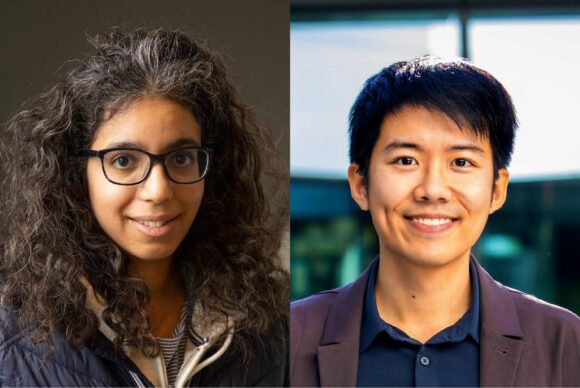
Nada Amin (left) and Sitan Chen (right) are both current Harvard faculty members whose pioneering research advances the Kempner Institute’s core scientific mission to understand the basis of natural and artificial intelligence.
CAMBRIDGE, MA — The Kempner Institute for the Study of Natural and Artificial Intelligence at Harvard is pleased to announce the appointment of Nada Amin and Sitan Chen as associate faculty members.
Amin and Chen are both current Harvard faculty members whose research advances the Kempner Institute’s core scientific mission to understand the basis of natural and artificial intelligence. The new appointees began their three-year appointments at the Kempner Institute on July 1, 2026.
Amin, who is associate professor of computer science at the Harvard John A. Paulson School of Engineering and Applied Sciences (SEAS), studies how programming languages and artificial intelligence can be combined to build intelligent systems that are “correct by construction” — designed from the start to behave reliably and as intended. One line of work combines large language models (LLMs) with program verifiers — software tools that check whether programs are correctly constructed — to generate verified programs at scale for training models and solving targeted problems. Amin received a 2026 Kempner Accelerator Award to support her team’s work on DafnySynth, a computational model that writes, proves, and repairs software under strict mathematical constraints.
“I am looking forward to working at the Kempner Institute as an associate faculty,” said Amin. “I’ve already enjoyed being an affiliate, especially mentoring undergraduate students in research as well as collaborating closely with Kempner fellows and faculty. My work to build intelligent systems that are correct by construction aligns well with the Kempner’s mission.”
Chen, who is assistant professor of computer science at Harvard SEAS and a member of the Theory of Computation group and the Harvard Quantum Initiative, develops the mathematical foundations of modern generative AI, especially diffusion and flow-based models. His group studies how intelligence can emerge from iterative refinement: systems that begin in uncertainty and gradually revise and improve their outputs.
“I’ve had many inspiring collaborations with researchers at the Kempner during my time at Harvard, and as a new associate faculty member, I’m eager to contribute to its efforts to understand intelligence in natural and artificial systems and learn from this amazing community,” said Chen. “I’m a big believer that theory for machine learning is most powerful when shaped by sustained dialogue with practice. The depth and breadth of expertise at the Kempner make it an ideal environment for pursuing this kind of work.”
Amin and Chen will join the institute’s 12 current associate faculty members. Kempner Institute associate faculty play a key role in the institute, working closely with fellow community members to foster collaborative research efforts, pursue new discoveries, design impactful educational programs, and direct the institute’s scientific growth.
About the Kempner Institute
The Kempner Institute seeks to understand the basis of intelligence in natural and artificial systems by recruiting and training future generations of researchers to study intelligence from biological, cognitive, engineering, and computational perspectives.
Its bold premise is that the fields of natural and artificial intelligence are intimately interconnected; the next generation of artificial intelligence will require the same principles that our brains use for fast, flexible natural reasoning, and understanding how our brains compute and reason can be elucidated by theories developed for AI. Join the Kempner mailing list to learn more, and to receive updates and news.