



Searching for Links Between Brain and Behavior in the Fruit Fly
New computational model uncovers neurons that coordinate fruit fly grooming behavior
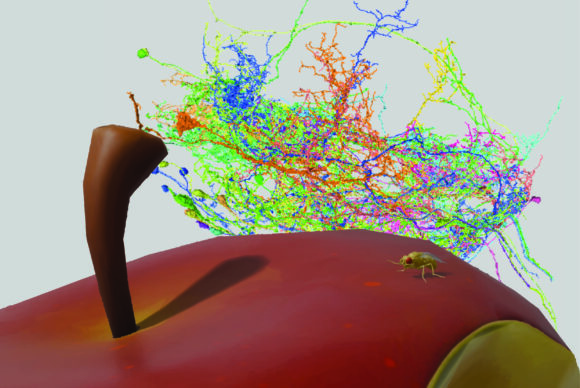
Researchers used a detailed wiring map of the fruit fly brain to reveal how different neuron types control antenna grooming behavior. In this illustration, a fruit fly perched on an apple is shown against a 3D reconstruction of 50 neurons from the grooming network, each rendered in a different color to distinguish individual cells.
Image: Gizem Özdil
At a Glance
- Researchers built a computational model from a detailed map of the fruit fly brain and used it to shed light on how fruit flies coordinate grooming behaviors.
- The computational model was used to identify 10 types of neurons that were likely involved in coordinating grooming movements.
- Experiments confirmed a key prediction of the model: activating a specific inhibitory neuron type caused flies to stop grooming almost immediately.
Understanding how specific neurons contribute to behavior is one of neuroscience’s central challenges. A new study of grooming behavior in fruit flies, recently published in Nature Communications, shows how a computational model built from a detailed map of the fruit fly’s neural connections — known as a connectome — can help address that challenge.
Led by Gizem Özdil, a research fellow at the Kempner Institute, the study used a detailed map of neural connections in the fruit fly brain to build a computational model of the network involved in antenna grooming. The model helped researchers sort through hundreds of neurons and predict 10 neuron types that were likely to play critical roles in coordinating antenna grooming movements.
The researchers then used lab experiments to test one of those model types in living flies, confirming that a particular type of neuron, known as a c23 neuron, helps perform a specific function: coordinating grooming by suppressing competing movements.
“This is one of the first works that shows we can infer actual behavior from the fruit fly’s connectome structure,” says Özdil. “In the fly field there is already a good amount of consensus on using the connectome to understand the function of individual neurons, but our study shows an important experimental link between computational model predictions and the actual fly behavior.”
“The exciting implication here is that this potentially paves the way for identifying neural underpinnings of other behaviors using similar tools and methodologies.”
Combining research tools to uncover centralized brain circuits coordinating behavior
In the fly, antennal grooming requires the head, antennae, and forelegs to move together in a precise way, and Özdil and her collaborators wanted to better understand the mechanisms in the fly brain that coordinate this complex grooming behavior. To do this, they developed a unique methodological approach that combined fly experiments in the lab, analysis of the fly connectome, and neural network modeling.
First, by conducting fly experiments in the lab, the researchers were able to learn that sensory feedback is not necessary for coordinating antennal grooming, suggesting that the behavior is largely feedforward, or driven by pre-planned motor commands from centralized neural circuits rather than ongoing moment-to-moment sensory corrections.
“This part of the research helped us understand how the fly brain coordinates multiple body parts to produce a complex behavior,” says Özdil. “More generally, this gives us an insight into how nervous systems can flexibly combine motor networks controlling different body parts to generate coordinated behaviors, which may be a general principle for understanding movement control across species.”
Building a computational model from a detailed brain map
The adult fruit fly brain has been mapped in extraordinary detail, revealing how thousands of neurons are connected to one another. While this map of connections can reveal potential routes for neural signals, it cannot by itself show which neurons are essential for a given behavior nor can it predict what will happen when specific neurons are manipulated.
This is where computer modeling comes in. Using their findings about the centralized control mechanism for antennae grooming, as well as pre-existing maps of the fly brain architecture, the researchers built a machine learning model that could simulate fly behavior and predict neural circuits involved in grooming.
The computational model uses machine learning techniques to reproduce key aspects of the grooming behavior, and once trained, it predicted which classes of neurons were most important for coordinating grooming movements. The researchers then tested one of these predictions in actual fruit flies and found that the computer model was able to accurately predict neural mechanisms driving grooming behavior.
“The advantage is that we can now try out the same kinds of perturbations in this neural network that we would normally do in a real fly, like activating or inhibiting certain neurons,” says Özdil. “This allows us to generate predictions from the model that we can then test experimentally.”
The importance of suppressing competing movements
One of the model’s key predictions involved c23 neurons, a type of inhibitory neuron, whose job is to block or reduce the activity of other neurons. The model suggested that c23 neurons might help coordinate grooming by suppressing movements that could interfere with the task at hand.
To test that idea, the researchers used an experimental technique called optogenetics, which allows them to activate specific neurons with light. When they activated c23 neurons while flies were grooming their antennae, the grooming behavior stopped — exactly as the model had predicted.
“The role of c23 neurons in grooming had not previously been identified, and we found that it was indeed essential for grooming behavior,” says Özdil.
While scientists already understood that inhibitory connections play a role in grooming behavior, by identifying the specific role of c23 neurons, the researchers were able to show that the same connectivity structure that is important for other tasks, such as decision-making, can be important for antennae grooming coordination.
“So the idea here is that it’s the same structure, the same connectome structure, gives rise to different behaviors,” says Özdil. “And the general implication is that we showed that a central network in the brain could be responsible for coordinating different body parts in a flexible manner.”
Beyond pointing to the flexibility of brain structures in coordinating different body functions, the study demonstrates how detailed brain maps can be combined with machine learning and targeted experiments to better understand the neural mechanisms underlying behavior.
Özdil is now extending these approaches to studies of movement in other animal species and to projects developing AI systems that control robotic movement. Insight into the fly brain, she says, can offer important inspiration in the development of future neural networks and other artificial systems.
“As we are looking into the fly brain and seeing the connectivity structures that underlie complex behaviors, the question is, can we borrow some of these structures to build better artificial systems?”