


Kempner Institute Announces Undergraduate Student Researchers for Summer 2026
Twelve Harvard undergraduates selected to undertake intensive summer research on intelligence as part of the KRANIUM program
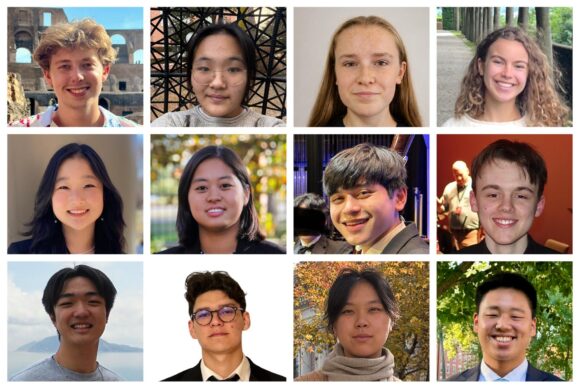
The 12 undergraduate students selected for this summer's KRANIUM program: Top row, left to right: Joel Bentley, Ash Bu, Zara Geddes, Betina Kreiman; Middle row, left to right: Jaehee Lee, Angela Mei, Zach Piesner, Dries Rooryck; Bottom row, left to right: Anthony Shen, Abdulaziz Sobirov, Hillary Tong, Yurui Zi.
Cambridge, MA — The Kempner Institute is pleased to announce its third cohort of undergraduate summer researchers selected for KRANIUM, a 9-week intensive summer research program in intelligence for Harvard undergraduates.
This summer’s participants will include 12 Harvard students at various stages of their undergraduate studies. Each student will be supervised by a Kempner-affiliated faculty member and will undertake an individual research project investigating the foundations of intelligence in natural and artificial systems. This summer’s student projects will cover a wide range of topics, from building generative AI models for protein binding to understanding how ideas or “concepts” are represented in artificial neural networks.
Sponsored by the Kempner Institute as part of the Harvard Summer Undergraduate Research Village (HSURV), KRANIUM (Kempner Research in Artificial & Natural Intelligence for Undergraduates with Mentorship) provides funding, room & board, mentorship, and a host of educational and community programming for participating students.
In addition to the KRANIUM summer program, the Kempner also offers undergraduate research opportunities during the fall and spring semesters through the KURE program. To learn more, visit the undergraduate research programs page on our website.
The full list of Summer 2026 KRANIUM participants, mentors and projects are listed below:
| KRANIUM student | Concentration | Supervisor/Mentor | Project title |
|---|---|---|---|
| Joel Bentley ’27 | Mathematics and Philosophy | Supervisor: Haim Sompolinsky Mentor: Lorenzo Tiberi | Hierarchical Representation of Concept Manifolds |
| Ash Bu ’29 | Mathematics | Supervisor: Tomer Ullman Mentor: Hanbei Zhou | The Einstein Project |
| Zara Geddes ’28 | Computer Science | Supervisor & Mentor: Mengyu Wang | Efficient Multimodal Language Models for Real-Time Assistive Smart Glasses |
| Betina Kreiman ’28 | Physics and Computer Science | Supervisor & Mentor: Susan Murphy | Multi-Armed Bandit Using Empirical Bayes |
| Jaehee Lee ’28 | Computer Science and Linguistics | Supervisor & Mentor: Synho Do | Developing an Agentic AI Layer on the Sanomap Project for Dermatological Microbial Data |
| Angela Mei ’27 | Computer Science and Chemistry | Supervisor: Yilun Du Mentor: Sarah Liaw | Learning the Binding Funnel: Energy-Based Generative Models for Protein-Ligand Binding |
| Zach Piesner ’28 | Computer Science and Statistics | Supervisor: Hawazin Elani Mentor: Ningsheng Zhao | Fairness and Moral-Dilemma Latents Under Domain Adaptation to Healthcare NLP |
| Dries Rooryck ’27 | Statistics | Supervisor & Mentor: Wilka Carvalho | Code-Switching in SLMs |
| Anthony Shen ’28 | Statistics and Mathematics | Supervisor & Mentor: Greta Tuckute | Reorganization of Audio Model Embedding Geometry During Novel Word Learning for Robust Speech Recognition |
| Abdulaziz Sobirov ’28 | Mathematics | Supervisor: Mengyu Wang Mentor: Advaith Ravishankar | VLP: Vision-Langage-Pose Model for Humanoid Loco-Manipulation |
| Hillary Tong ’29 | Computer Science and Statistics | Supervisor: Bernardo Sabatini Mentors: Tom Wheatcroft and Priya Srikanth | Unsupervised Inference of Behavioral Latents and States Through Video Analysis |
| Yurui Zi ’28 | Special Concentration: Rationality and Decision Theory | Supervisor: Sam Gershman Mentor: Arthur Prat-Carrabin | Computationally Modelling Belief Updating Using Meta-Bayesian Inference |
About the Kempner Institute
The Kempner Institute seeks to understand the basis of intelligence in natural and artificial systems by recruiting and training future generations of researchers to study intelligence from biological, cognitive, engineering, and computational perspectives. Its bold premise is that the fields of natural and artificial intelligence are intimately interconnected; the next generation of artificial intelligence (AI) will require the same principles that our brains use for fast, flexible natural reasoning, and understanding how our brains compute and reason can be elucidated by theories developed for AI. Join the Kempner mailing list to learn more, and to receive updates and news.