


A Celebration of Student Research at Inaugural Kempner Graduate Fellow Symposium
Click white arrows to view the slideshow.
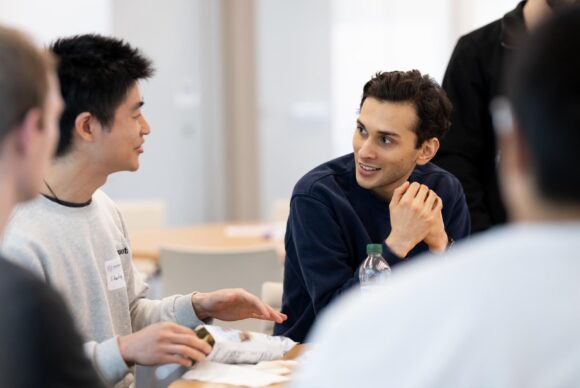
Kempner Graduate Fellow Sabarish Sainathan (right) at the Kempner Graduate Fellow Symposium on April 3, 2026. Photo: Anna Olivella
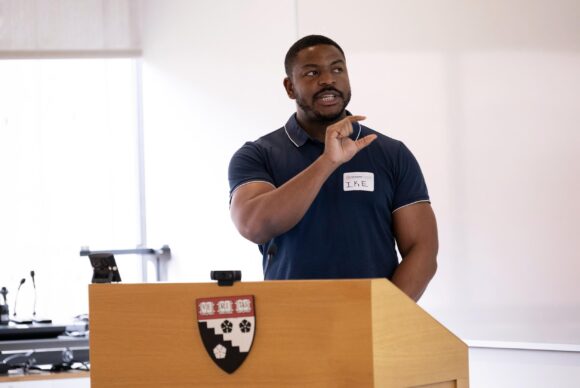
Graduate Fellow Ikechukwu Uchendu presenting his work, which uses AI models to optimize the design of computer chips. Photo: Anna Olivella
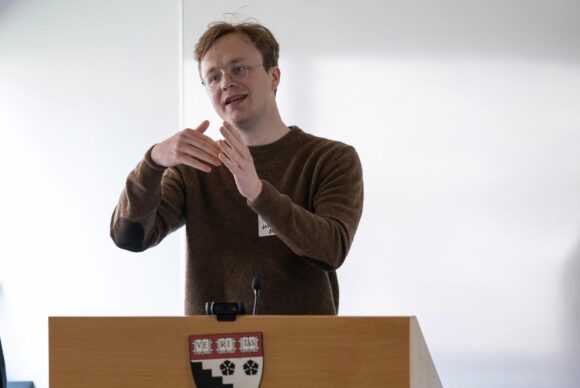
Graduate Fellow Gustaf Ahdritz presenting his work on mitigating hallucinations in AI models. Photo: Anna Olivella
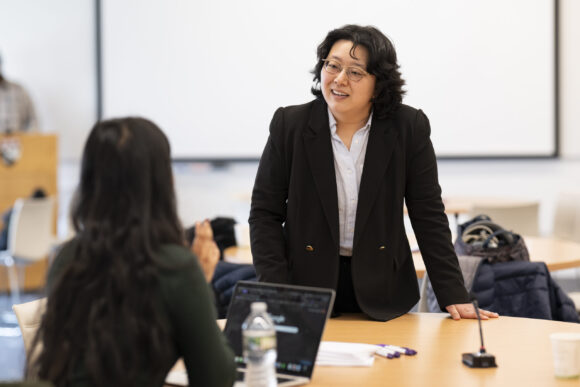
Denise Yoon, Associate Director for Educational Programs at the Kempner Institute and one of the organizers of the symposium, chats with one of the attendees. Photo: Anna Olivella
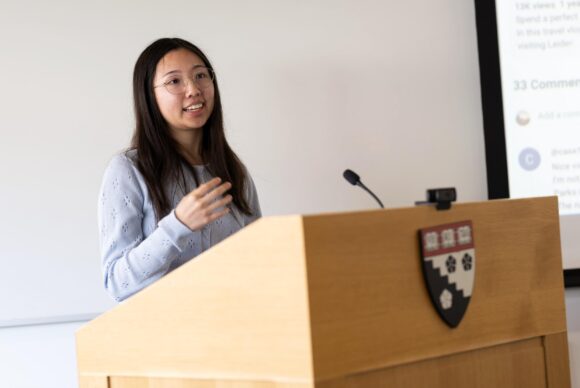
Graduate Fellow Catherine Yeh presents her work on telling stories with and about AI. Photo: Anna Olivella
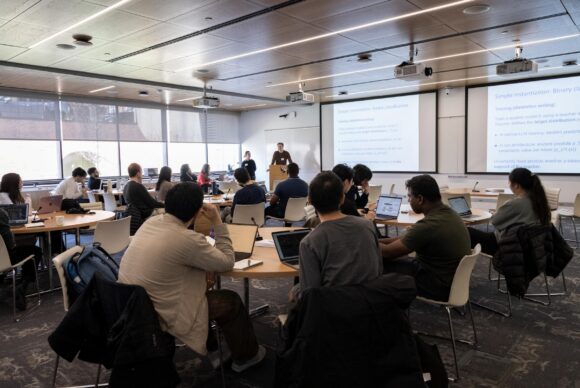
Attendees watch the presentation by Graduate Fellows Anat Kleiman and Gustaf Ahdritz at the Gutman Conference Center. Photo: Anna Olivella
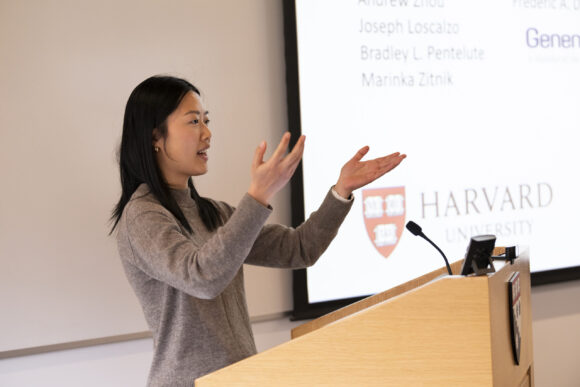
Graduate Fellow Ada Fang presents her work on the use of AI for biomedical research. Photo: Anna Olivella.
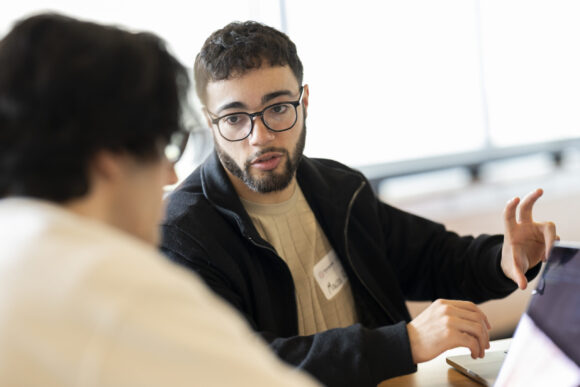
Deep in discussion: Kempner Post-Bac Scholar Maceo Richards attends the 2026 Kempner Graduate Fellow Symposium. Photo: Anna Olivella
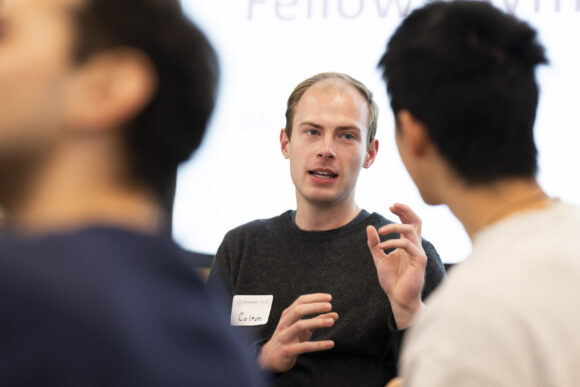
Graduate Fellow Colton Casto at the Kempner Graduate Fellow Symposium on April 3, 2026. Photo: Anna Olivella
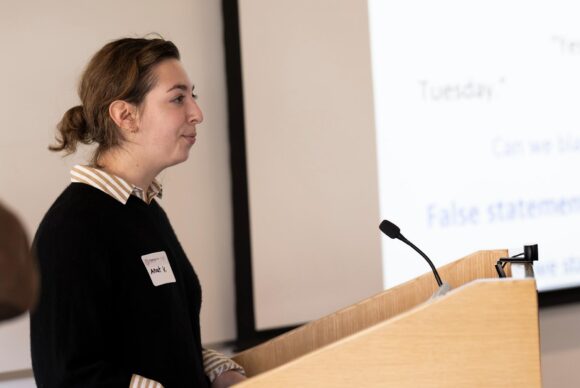
Graduate Fellow Anat Kleiman presents her research on mitigating hallucinations in AI models. Photo: Anna Olivella
On April 3, the Kempner Institute hosted its first Kempner Graduate Fellow Symposium, offering Kempner graduate fellows the opportunity to share their research with other scientists and potential collaborators. The full-day event featured talks from 11 Kempner graduate fellows, all of whom study intelligence in natural or artificial contexts and are in their fourth year of study towards a Ph.D. at Harvard.
“An important part of being a scientist is being able to communicate your work and share your findings with other researchers,” explains Denise Yoon, Associate Director for Educational Programs at the Kempner. “It’s important to give our students the opportunity to seek out scientific collaborations and connections early in their careers, and for them to get that experience not only through presenting at conferences, but also by connecting across the local community at both the Kempner and across Harvard.”
“It’s important to give our students the opportunity to seek out scientific collaborations and connections early in their careers, and for them to get that experience not only through presenting at conferences, but also by connecting across the local community at both the Kempner and across Harvard.”
Denise Yoon, Associate Director for Educational Programs
At the symposium, the students, who are working towards their doctoral degrees within academic departments across Harvard, presented to an audience of 55 students, researchers and faculty. The symposium was organized into three sessions: Language Models and Meaning, Representation and Exploration in AI, and AI for Science, Engineering, Behavior.
Specific presentation topics ranged from computer chip design and large language models (LLMs) to neuroscience. A few snapshots: Ada Fang, a Kempner graduate fellow and Ph.D. student in chemistry, presented some of the tools that she has built for biochemical interaction modeling and ended with her work on ClawInstitute, a social network that allows for collaboration between AI scientists. In another presentation, Sonia Murthy, a Kempner graduate fellow and Ph.D. student in computer science, discussed her work on how cognitive models reveal trade-offs in LLMs.
The full list of student presentations is below. Learn more about the Kempner Graduate Fellowship on the Kempner Institute website.
Graduate Fellow Talks
| Kempner Graduate Fellow | Presentation |
| Usha Bhalla | Interpreting Temporal and Geometric Structures in LLMs |
| Ada Fang | Learning and Automating Biomolecular Research with AI |
| Ikechukwu Uchendu | Vision Language Models for Computer Chip Design |
| Yongsoo Ra | Testing the Role of Dopamine in Off-policy Motor Learning |
| Rosie Zhao | Matching Features, Not Tokens: Energy-Based Fine-Tuning of Language Models |
| Catherine Yeh | Telling Stories With and About AI: Visualizing and Shaping Meaning from Unstructured Data |
| Gustaf Ahdritz and Anat Kleiman | Sub-probabilistic Modeling for Mitigating Hallucinations |
| Sabarish Sainathan | How Feature Learning Responds to Correlation Blowup and Localization |
| Yuyang Zhang | Diffusion Policies for Improved Exploration in Online Reinforcement Learning |
| Sonia Murthy | Using Cognitive Models to Reveal Value Trade-offs in Language Models |