

Inaugural Kempner Post-Baccalaureate Capstone Showcases Work of First Cohort
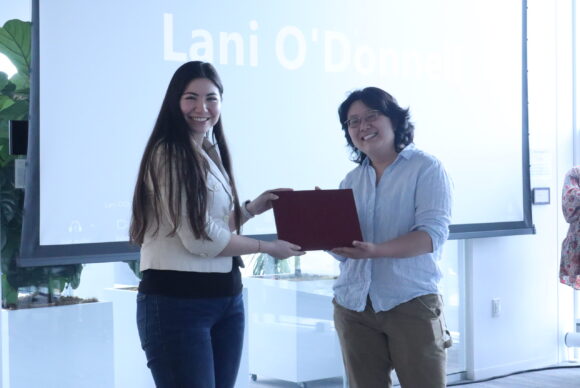
Leilany Torres Diaz (left) receiving a certificate marking her completion of the Kempner Post-Baccalaureate Program from Denise Yoon (right), Associate Director for Educational Programs, Kempner Institute.
Photo credit: Lizette Ortega
Allston, MA — The Kempner Institute recently hosted its inaugural Post-Baccalaureate Capstone Event, celebrating the first four scholars as they near completion of the Kempner Post-Baccalaureate Program and highlighting their two years of intensive, mentored research.
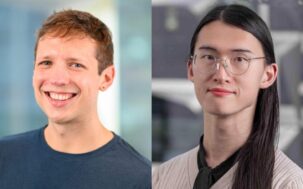
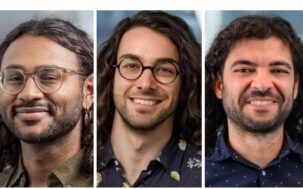
Held in partnership with post-baccalaureate programs at the Harvard John A. Paulson School of Engineering and Applied Sciences (SEAS) and the Harvard Quantum Initiative (HQI), the event brought together post-bac scholars, faculty mentors, and community members for research presentations and discussion. Three Kempner post-bacs — Lyndon Lam, Maceo Richards, and Leilany Torres Diaz — presented their capstone projects; a fourth scholar, Haylin Diaz, was unable to attend and shared her work through a presentation delivered on her behalf.
The Kempner Post-Baccalaureate Program, offered in collaboration with the Harvard Griffin Graduate School of Arts and Sciences Research Scholar Initiative (RSI), provides recent college graduates with two years of full-time, mentored research experience with Kempner-affiliated faculty. Scholars receive a stipend, tuition support for coursework, and structured professional development as preparation for graduate study and research careers.
“The Kempner post-bac program gives students who may not have had prior research opportunities a chance to engage deeply in research,” said Denise Yoon, the Institute’s associate director of educational programs. “This first cohort, and the innovative capstone projects they are presenting today, demonstrate the impact of that investment.”
Presentations by post-bacs in the Kempner and SEAS programs took place on May 11 in the Kempner Institute’s large conference room and were followed by question-and-answer sessions. The event concluded with an informal ceremony in which scholars received certificates recognizing their completion of the post-bac program, as well as awards created by the first-year post-bacs. Conversations about neuroscience, artificial intelligence, and research life continued at a catered reception in the Kempner Atrium.
Capstone Projects from the First Cohort
Haylin Diaz’s capstone project focused on using AI as a tool and partner in mathematics education. Diaz was mentored by Kempner Institute Co-Director Sham Kakade and Kempner associate faculty member David Alvarez-Melis.
Lyndon Lam presented research on design choices in vision-language AI models, comparing approaches for transferring information between visual and textual representations. He was mentored by Kempner Co-Director Sham Kakade, and collaborated with Institute Investigator Yilun Du, Graduate Fellow Rosie Zhao, and senior ML research engineers Yasin Mazloumi and Timothy Ngotiaoco.
Maceo Richards presented computational neuroscience research on how biological neurons perform computations, focusing on the role of dendrites in shaping neural processing. He was mentored by Kempner Co-Director Bernardo Sabatini and worked closely with senior ML research scientist Houman Safaai.
Leilany Torres Diaz presented computational neuroscience work examining the alignment between leading artificial vision models and brain data, exploring how well current AI systems capture human visual representations. Her primary mentor was Kempner affiliate faculty member George Alvarez.
Cross-Program Engagement
Two SEAS post-bac scholars, Jonathan Chinana and Caitlin Westgate, also shared their research. Chinana described his work on stingray morphology and hydraulic control optimization, while Westgate’s presentation covered her work on microtubules in biological neurons. Their certificates for completing the SEAS post-bac program were awarded by Lizette Ortega, assistant director, Office for Belonging, Engagement, and Community at SEAS.
Next Steps
The members of this inaugural cohort are already translating their Kempner experience into the next stages of their academic and professional journeys. Several of them plan to pursue their PhDs — Haylin Diaz will begin her PhD work in computer science at Fordham University, and Maceo Richards will join Harvard’s Program in Neuroscience as a PhD student. Other members are exploring graduate school pathways as well as industry careers. Their paths illustrate the program’s central goal — to open new doors into advanced study and research careers for emerging scientists in AI and neuroscience.
About the Kempner Institute
The Kempner Institute seeks to understand the basis of intelligence in natural and artificial systems by recruiting and training future generations of researchers to study intelligence from biological, cognitive, engineering, and computational perspectives. Its bold premise is that the fields of natural and artificial intelligence are intimately interconnected; the next generation of artificial intelligence (AI) will require the same principles that our brains use for fast, flexible natural reasoning, and understanding how our brains compute and reason can be elucidated by theories developed for AI. Join the Kempner mailing list to learn more, and to receive updates and news.