




Postdoctoral AI Researchers
These positions are designed for candidates who have completed a PhD within the last two years and are eager to deepen their research programs, contribute to open and reproducible science, and continue developing as scholars within a highly collaborative research environment.
Applications are now open.
Application deadline: June 8, 2026
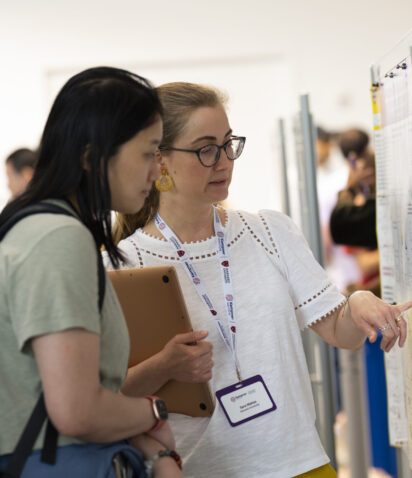
The Kempner Institute for the Study of Natural and Artificial Intelligence at Harvard University seeks early-career researchers with deep expertise in modern AI/ML to serve as Postdoctoral AI Researchers.
Postdoctoral AI Researchers will contribute to ambitious, team-science research at the frontier of modern machine learning and science. Current positions span three areas:
- Foundation models, scientific applications, and AI systems;
- NeuroAI and computational neurobiology; and
- Cellular and protein computational biology.
These positions are designed for candidates who have completed a PhD within the last two years and are eager to deepen their research programs, contribute to open and reproducible science, and continue developing as scholars within a highly collaborative research environment.
The anticipated start date is October 15, 2026. These are full-time, benefits-eligible, on-site positions based at the Kempner Institute at Harvard University.
Current positions
There are three Postdoctoral AI Researcher positions, each with a distinct research focus and background expectations.
Postdoctoral AI Researcher in AI/ML for Foundation Models, Scientific Applications, and AI Systems
- This position is for candidates with strong foundations in modern machine learning and the ambition to advance foundation models, agentic workflows, tool-augmented models, and AI systems for high-impact scientific applications, including the life sciences.
- Ideal candidates will have experience with foundation model training, evaluation, scaling, adaptation, or post-training; agentic workflows; tool use; retrieval systems; large-scale datasets; distributed training; high-performance computing; alternative architectures; or systems-level approaches to modern AI.
Postdoctoral AI Researcher in AI/ML for NeuroAI and Computational Neurobiology
- This position centers on computational neurobiology and the use of modern AI/ML methods to model brain circuits and neural activity. Researchers may contribute to the development of brain foundation models that predict patterns of neural activity from large-scale, multi-regional recordings.
- Ideal candidates will have experience with computational neurobiology, neural data analysis, time-series modeling, sequential models, transformers, autoencoders, dynamical systems models, or modeling neural activity from large-scale recordings.
Postdoctoral AI Researcher in AI/ML for Cellular and Protein Computational Biology
- This position focuses on applying modern AI/ML methods to protein and cellular biology, including protein structure prediction, protein–protein and small-molecule–protein docking, cell-state prediction from large-scale perturbation datasets, and multimodal modeling of protein function and cellular state.
- Ideal candidates may have experience with computational biology or biological data analysis; protein structure modeling and docking; cell-state modeling from Perturb-seq or related datasets; multimodal modeling for protein or cellular tasks; or familiarity with AlphaFold, RFDiffusion, CellCap, or related systems.
Research experience
Postdoctoral AI Researchers contribute to ambitious research projects at the frontier of AI/ML and its scientific applications. They work closely with Kempner investigators and research teams to develop research questions, design experiments, analyze results, and contribute to new ideas, methods, models, and scientific understanding.
These positions are intended for candidates who are excited to contribute to large-scale, high-impact research projects within broader Kempner research teams. Compared with some traditional postdoctoral appointments, these roles are more focused on collaborative, compute-intensive projects than on fully independent research directions, and are designed to help researchers develop new skills in modern AI/ML and its scientific applications.
For all positions, applicants should have:
- A PhD in a relevant field by the expected start date. Relevant fields may include computer science, statistics, electrical engineering, applied mathematics, computational biology, computational neuroscience, neurobiology, bioengineering, biophysics, physics, or a related quantitative field, depending on the position.
- A PhD received on or after September 15, 2024, or expected completion of all PhD requirements by the anticipated start date of October 15, 2026.
- Demonstrated expertise in modern AI/ML, including deep learning.
- Hands-on experience with PyTorch, JAX, or a similar framework.
- Experience implementing, training, evaluating, fine-tuning, or adapting modern machine learning models.
- Strong programming skills in Python and experience building or maintaining research code.
- A strong record of research productivity, such as publications in leading venues, substantial open-source research contributions, or comparable scholarly accomplishments.
- Ability to use modern AI-assisted or agentic coding tools effectively, such as Claude Code, Codex, or similar systems.
- Ability to work effectively in a collaborative research environment and communicate technical work clearly.
- The appointment is for one year. Reappointment may be possible for up to a total of three years, contingent on funding, project needs, satisfactory performance, and mutual interest.
- This is a full-time, benefits-eligible postdoctoral appointment based at the Kempner Institute at Harvard University.
- Because in-person mentoring and collaboration are critical to the role, remote work is not possible. The position is fully on-site at Harvard University.
- The expected salary is $100,000, subject to compliance with applicable salary requirements for the appointment.
- The anticipated start date is October 15, 2026.
Applications are due by 11:59 p.m. ET on Monday, June 8, 2026.
Applicants should submit the following materials in PDF format:
- CV
- Research statement of no more than two pages
- Names and contact information for 2–3 references
The research statement should describe relevant prior research experience and should be specific about the applicant’s individual contributions. Applicants should tailor the statement to the position to which they are applying.
Candidates selected for further consideration will be asked to submit a short video presentation reviewing their past work; additional details will be provided at that stage. Following review of the videos, a subset of candidates will be invited to interview with members of the selection committee via Zoom.
Applications received after the deadline may be reviewed on a rolling basis if positions remain available.
Please apply to the position that best matches your background and interests: