


Kempner Institute Welcomes Spring 2026 Undergraduate Student Researchers
Twenty Harvard College students receive KURE awards to undertake research projects focused on intelligence
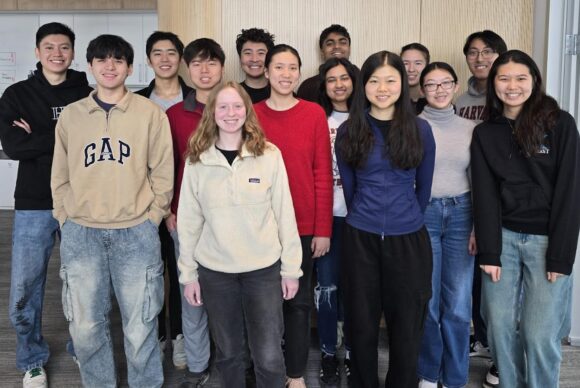
A group of spring 2026 KURE undergraduate researchers pose for a photo at the program orientation at the Kempner Institute in February 2026. Photo credit: Lani O'Donnell
Cambridge, MA – The Kempner Institute for the Study of Natural and Artificial Intelligence at Harvard University is pleased to announce the spring 2026 recipients of the Kempner Undergraduate Research Experience (KURE) awards. KURE funds Harvard undergraduate students during the fall and spring semesters of the academic year for research projects supervised by Kempner-affiliated faculty.
These research projects investigate the foundations of intelligence, including mathematical and computational models of intelligence, cognitive theories of intelligence, and the neurobiological basis of intelligence, as well as applications of artificial intelligence in science and engineering.
“In a field like intelligence, where the frontier is constantly moving, research experiences are essential,” says Denise Yoon, Associate Director for Educational Programs at the Kempner Institute. “This is what KURE offers—the opportunity for students to implement what they’ve learned in the classroom and tackle real-world problems.”
In addition to its term-time undergraduate research program, the Kempner offers a 10-week residential summer program called KRANIUM. More information about KURE and KRANIUM can be found on the Kempner Institute website.
The spring 2026 KURE recipients (listed below) represent the fifth cohort of undergraduates to participate in the Kempner’s term-time undergraduate research program.
Spring 2026 KURE Award Recipients
| Student | Concentration | Supervisor/Mentor | Project title |
|---|---|---|---|
| Sam Chen ‘28 | Computer Science and Mathematics | Supervisor: Kianté Brantley Mentor: Elom Amematsro | End-to-End Hierarchical Reinforcement Learning via Inference-Based Subgoal and Skill Discovery |
| Victoria Chen ‘28 | Psychology and Statistics | Supervisor: Ashley Thomas Mentor: Hannah Hok Kim | Predicting Collaborative Task Performance from Social Affiliation |
| Eric Ge ‘28 | Computer Science and Mathematics | Supervisor: Yilun Du Mentor: Weirui Ye | Multi-Agent Search for Test-Time Reasoning |
| Emma Harris ‘27 | Computer Science | Supervisor: Nada Amin Mentor: Simon Henniger | Towards Automating the Addition of Verification to Programming Problems |
| Helen He ‘26 | Computer Science and East Asian Studies, Secondary in Classics | Supervisor: Yilun Du Mentor: Ruojin Cai | 3D Computer Vision for Medieval Chinese Dance Reconstruction |
| Lavik Jain ‘27 | Computer Science and Physics | Supervisor: Kianté Brantley Mentor: Elom Amematsro | Dual-Learning for Efficient and Stable Transformer Adaptation |
| Kayden Kehe ‘27 | Computer Science | Supervisor: Melanie Weber Mentor: T. Anderson Keller | Unitary Flow Equivariant Recurrent Neural Networks |
| Victoria Li ‘26 | Computer Science and Statistics | Supervisor & Mentor: Yonatan Belinkov | Do Vision-Language Models See Charts Like We Do? |
| Bryan Lim ‘28 | Computer Science and Statistics | Supervisor & Mentor: Mengyu Wang | Representational Sufficiency for 3D Spatial Reasoning in Vision Language Models |
| Kevin M. Liu ‘27 | Computer Science and Mathematics | Supervisor: Cengiz Pehlevan | Mechanistic Transitions Between Memorization and In-Context Learning |
| Serena Liu ‘29 | Electrical Engineering | Supervisor: Mengyu Wang Mentor: Advaith Ravishankar | Leveraging World Models for Pairwise Dense Reward Generation in Vision-Language-Action Policy Learning |
| Adithya Madduri ‘27 | Molecular & Cellular Biology and Statistics | Supervisor: Bernardo Sabatini | Dendritic Computation in Hierarchical Vision Models |
| Sophie Pearo ‘27 | Computer Science and Statistics | Supervisor: Bernardo Sabatini Mentor: Celia Beron | Learning Decision-Making Strategies from Sequential Behavior |
| Zachary Piesner ‘28 | Statistics and Computer Science | Supervisor: Hawazin Elani Mentor: Ningsheng Zhao | Confounding-Robust Explanations for Heterogeneous Treatment Effect Models |
| Aseel Rawashdeh ‘26 | Statistics and Computer Science | Supervisor and Mentor: T. Anderson Keller | Adaptively Damped Oscillatory Sequential Models |
| Itzel Sanchez ‘26 | Neuroscience and Computer Science | Supervisor and Mentor: Ilenna Jones | Dendritic Correlates of Gradient Based Learning in Neural Credit Assignment |
| Saranya Singh ‘28 | Computer Science and Mathematics | Supervisor: Nada Amin | A Process-Verified LLM System |
| Johnathan Sun ‘26 | Applied Mathematics | Supervisor: Yonatan Belinkov | Economic Representations in Large Language Models |
| Eric Xu ‘28 | Computer Science | Supervisor: David Alvarez-Melis Mentor: Nihal Nayak | Using Gradient-Based Influence Functions to Optimize Synthetic Data Generation |
| Kaden Zheng ‘27 | Computer Science and Neuroscience | Supervisor: Naomi Saphra | Sequence Modeling of Electrocommunication in Weakly Electric Fish |
About the Kempner Institute
The Kempner Institute seeks to understand the basis of intelligence in natural and artificial systems by recruiting and training future generations of researchers to study intelligence from biological, cognitive, engineering, and computational perspectives. Its bold premise is that the fields of natural and artificial intelligence are intimately interconnected; the next generation of artificial intelligence (AI) will require the same principles that our brains use for fast, flexible natural reasoning, and understanding how our brains compute and reason can be elucidated by theories developed for AI. Join the Kempner mailing list to learn more, and to receive updates and news.