



Kempner Institute Undergraduate Summer Internship Program in AI/ML Research & Engineering
Our 10-week summer internship in AI/ML research & engineering offers current undergraduates the opportunity to gain hands-on experience in a state-of-the-art research community.
Applications for Summer 2026 are now open and candidate applications are reviewed on a rolling basis.
We encourage candidates to submit an application no later than Monday March 30, 2026 to ensure your application is reviewed with the first cohort under consideration.
Overview
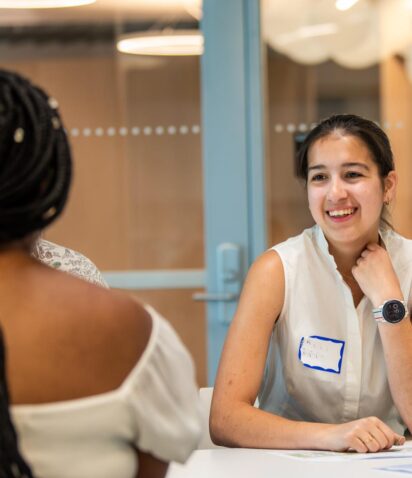
The Undergraduate Summer Internship Program in AI/ML Research & Engineering at the Kempner Institute offers a structured opportunity for current undergraduates (interns) and recent graduates to deepen their experience in AI/ML, computational research, and engineering in an academic setting. The program is designed for students who are excited by research and technical problem-solving, including those with interests in machine learning, computational neuroscience, and related quantitative fields.
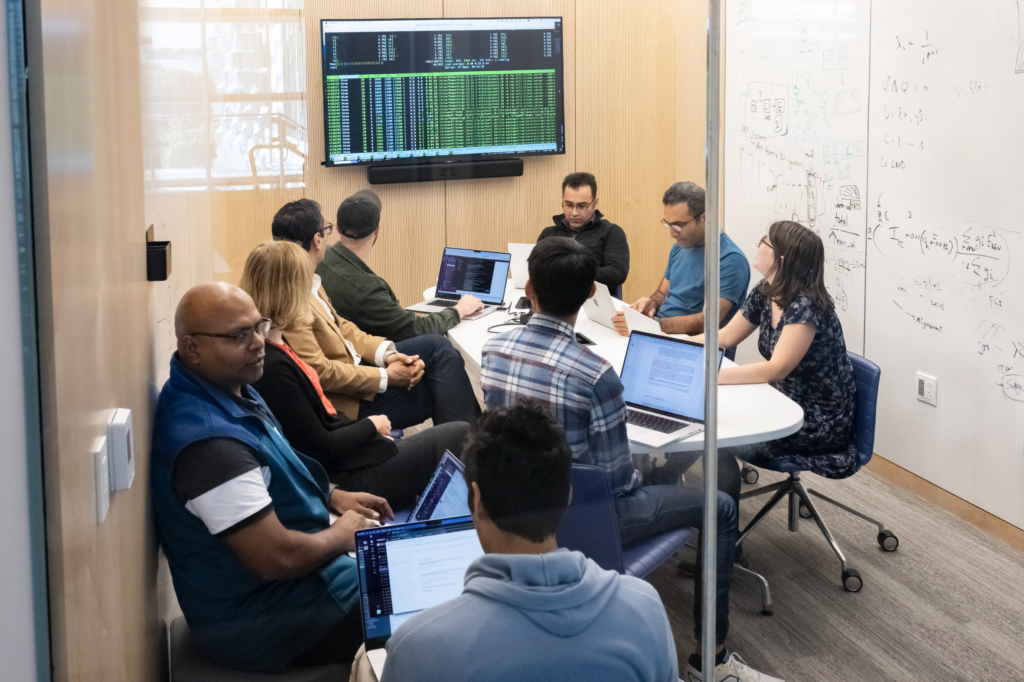
Interns will be mentored by a member of the Kempner Institute Research & Engineering Teams and will work on a Kempner Institute research project under the leadership of one of the Institute’s faculty. Projects may involve a combination of software development, model training, simulation, data analysis, evaluation, and experimental design, depending on the needs of the project and the intern’s background and interests.
Products resulting from the intern activities such as code, models, or datasets, may be published on Kempner Institute public channels, including GitHub, Hugging Face, or our Deeper Learning research blog.
Projects for summer 2026 include:
- ML Systems Engineering in Scalable Brain Simulation: The Big Little Brain (BLB) project at Kempner Institute develops a scalable computational framework to simulate how brain-inspired neural representations support learning, memory, and adaptive behavior in controlled virtual environments. The intern will help engineer large-scale computational systems that simulate learning, memory, and adaptive behavior in brain-inspired models and the opportunity to learn about complex systems. This includes implementing reinforcement learning agents, modular neural network architectures, building configurable virtual environments, and constructing scalable training and evaluation pipelines, within a broader modular system design framework. The work combines hands-on coding, ML engineering, system design, experiment automation, and structured analysis of emergent behavior. (Note: This project is no longer available; position has been filled for summer 2026.)
- Developing State of the Art Multimodal Models: At Kempner Institute, we aim to train a state-of-the-art open-source multimodal model. Through acquiring new data, building and optimizing end-to-end pipelines for training billion-parameter models, and developing a strong evaluation framework, we seek to build models with a deep understanding of the world, gaining reasoning abilities about both text and visual information. We are looking for an intern who will help engineer the large-scale systems needed to train large multimodal models. This work includes building data preprocessing pipelines, optimizing training on an HPC cluster, and performing end-to-end experiments on new architectures and data. (Note: This project is no longer available; position has been filled for summer 2026.)
- Dendritic Modeling: The student will use the existing dendritic network codebase to run a focused set of large-scale computational experiments that test scalability and robustness of dendritic networks with shunting (divisive) inhibition against matched baselines (e.g., linear/additive E–I models and standard MLPs) under controlled task and noise conditions. They will build a reproducible evaluation pipeline and systematically sweep key architectural and operating-point parameters (e.g., morphology, depth, E/I pooling constraints, shared-gain vs. load-noise regimes), producing clean plots and ablation-style analyses that probe how behavior changes as data and task complexity increase. The larger goal of this project is to understand different aspects of computational properties of dendritic networks and the role and function of dendritic structure and shunting inhibition in information processing. (Note: This project is no longer available; position has been filled for summer 2026.)
- Computational Neuroscience of Navigation and Learning in the Big Little Brain: You’ll work on a component of a modular, biologically-grounded model of the mouse brain, embedded in an agent navigating in simulated environments. The specific focus area is flexible based on your interests and where the project stands by summer, and could include work on spatial navigation circuits, sensory processing, or reinforcement learning. The broader goal is to understand how distinct brain systems coordinate to produce intelligent, adaptive behavior. Candidates with some experience with computational neuroscience preferred, but not required. (Note: This project is no longer available; position has been filled for summer 2026.)
Requirements
The program is fully on-site, in person, at the Kempner Institute located at Harvard’s Science and Engineering Complex (SEC) at 150 Western Avenue, Allston, MA.
- Remote work is not possible in this position.
- Applicants must be legally eligible to work in the United States. Visa sponsorship is not available for this position.
Technical skills required:
- Proficiency in coding (Python) and deep learning frameworks (PyTorch) with a drive to strengthen these skills.
- Familiarity with at least one relevant area of AI/ML — such as natural language processing, computer vision, reinforcement learning, generative models, computational neuroscience, or scientific machine learning — or a strong interest in developing expertise in these areas.
- Basic data preprocessing, computational analysis, feature engineering, or model evaluation, or a strong willingness to gain hands-on experience.
- Eagerness to learn HPC concepts, including parallel computing, distributed systems, and optimization.
- Analytical skills, problem-solving abilities, and a growth mindset.
Basic qualifications:
- Applicants must be enrolled full-time in an undergraduate degree program or have earned a bachelor’s degree within the last year (i.e. after 5/1/2025).
- The program requires a commitment of 35 hours per week.
- The position starts Monday June 15, 2026 and ends Friday August 21, 2026. An earlier start date may be available at the discretion of the program.
- Students must be able to participate for the full 10 weeks of the program.
- Candidates must be legally eligible to work in the United States. Visa sponsorship for this position is not available.
- Candidates must provide their own housing; there is no housing included as part of this internship.
How to apply
Candidate applications are reviewed on a rolling basis but we encourage candidates to submit an application no later than Monday March 30, 2026 to ensure your application is reviewed with the first cohort under consideration.
Selected candidates will move through an interview process conducted over Zoom.
Harvard is an equal opportunity employer and all qualified applicants will receive consideration for employment without regard to race, color, sex, gender identity, sexual orientation, religion, creed, national origin, ancestry, age, protected veteran status, disability, genetic information, military service, pregnancy and pregnancy-related conditions, or other protected status.
This application is now closed.