AI on the Move
At a Kempner seminar, EPFL professor Alexander Mathis traces a decade of progress in musculoskeletal AI agents
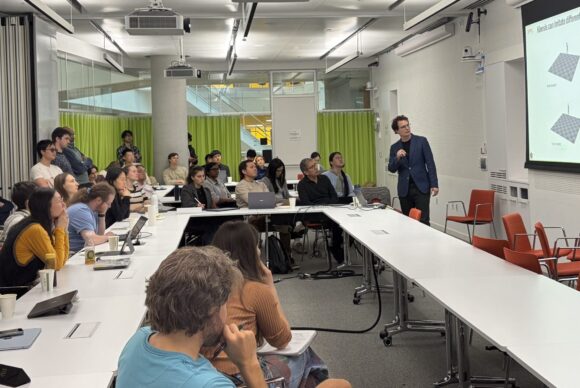
Alexander Mathis gives a talk at the Kempner Seminar Series on Thursday, November 12. Mathis discussed how researchers are meeting the challenge of building AI that can reproduce complex musculoskeletal movements.
Reproducing complex musculoskeletal movements, like the kind a human might use to return a table-tennis serve or score a soccer goal, has long posed a major challenge for AI systems. At a Kempner Institute seminar on Thursday, Alexander Mathis, Associate Professor at the Brain Mind Institute at EPFL, discussed how researchers are meeting this challenge.
Over the past decade, researchers have used increasingly sophisticated musculoskeletal simulations to explore how AI agents can navigate and interact with a dynamic physical environment. In his talk, titled “The Neuroscience of Skill: Lessons from a Decade of Musculoskeletal AI,” Mathis traced agents’ progress through a series of annual competitions that challenge researchers to build AI controllers for physiologically realistic musculoskeletal models.
Held each year since 2017 in conjunction with the Conference on Neural Information Processing Systems, these competitions present these models with complex simulated tasks, like scoring a penalty kick or manipulating Baoding balls, that call for the precise coordination of multiple joints and muscles. To master these tasks, researchers used two complementary machine-learning approaches: imitation learning, in which AI agents learn by mimicking a demonstration of successful movements, and reinforcement learning, in which they pursue a goal through trial and error.
As the AI models improved, they showed periodic dips in performance before rising to a higher peak, a pattern that Mathis links to an influential theory of motor learning first proposed in 1967 by the American psychologists Paul Fitts and Michael Posner.
According to this theory, motor skills are acquired and refined in three stages. First is the cognitive stage, in which a learner consciously deliberates on the steps needed to perform a task. Second is the associative stage, in which one’s knowledge of what to do is translated into how to do it. Last is the autonomous stage, in which the skill can be applied with minimal conscious control.
These performance dips, suggests Mathis, might be analogous to how human learners identify ways to improve their technique by breaking down their movements into conscious steps, stepping back into the cognitive stage.
Beyond advancing the development of more dexterous and agile robots, Mathis’s research could help shed light on how humans acquire motor skills, with potential applications in prosthetics, rehabilitation, and assistive technologies.
This talk was part of the Kempner Seminar Series, a research-level seminar series that brings leading intelligence scientists to Harvard to share their research.