Kempner Institute Welcomes Fall 2026 Undergraduate Researchers
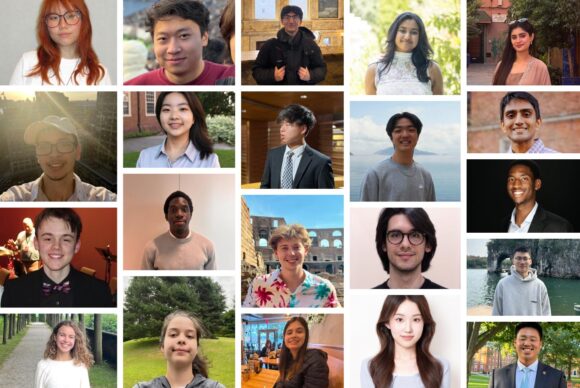
Twenty-one Harvard undergraduate students have received KURE fellowships for fall 2026. The fellowships provide funding and mentorship for participants to pursue intensive research projects related to intelligence.
Cambridge, MA – The Kempner Institute for the Study of Natural and Artificial Intelligence at Harvard is excited to announce the fall 2026 recipients of the Kempner Undergraduate Research Experience (KURE). KURE awards funding to Harvard undergraduate students during the fall and spring semesters of the academic year to undertake research projects supervised by Kempner-affiliated faculty and mentors.
This year, students are exploring the foundations of intelligence to better understand how systems learn and represent information, with areas of focus ranging from speech generation and spatial reasoning to multilingual capabilities and collaboration between agents. Their research projects will also investigate ways to improve model efficiency, interpretability and generalization, while applying artificial intelligence to real-world challenges such as clinical trial optimization, public housing resource allocation and scientific knowledge management.
Twenty one Harvard undergraduate students received fall 2026 KURE awards, representing the sixth and largest cohort of undergraduates to participate in the Kempner’s term-time undergraduate research program since its launch in 2024. In addition to KURE, the Kempner also offers a 10-week residential summer research program known as the Kempner Research in Artificial & Natural Intelligence for Undergraduates with Mentorship (KRANIUM) in partnership with the Harvard Summer Undergraduate Research Village (HSURV).
To be eligible for either KURE or KRANIUM, students must secure a research position with a Kempner-affiliated faculty member prior to applying. More information about KURE and KRANIUM can is available on the Kempner Institute website. The full list of the fall 2026 KURE program participants, mentors and projects can be found below.
Fall 2026 KURE Award Recipients
| Student | Concentration | Supervisor/Mentor | Project title |
|---|---|---|---|
| Adithya Madduri ’27 | Molecular & Cellular Biology and Statistics | Superviso: Bernardo Sabatini | Understanding What Makes Dendritic Neural Networks Efficient |
| Anthony Shen ’28 | Statistics and Mathematics | Supervisor: Greta Tuckute | Causal Steering Dynamics of Lexical Commitment in a Self-Supervised Speech Model |
| Ashley Zheng ’28 | Computer Science and History | Supervisor: Yilun Du; Mentor: Haonan Chen | Equivariant World Models |
| Ayesha Kashif ’29 | Applied Mathematics and Computer Science | Supervisor: Mengyu Wang | Geometry-Verified World-Model Distillation for Spatial Reasoning in VLMs |
| Betina Kreiman ’28 | Physics and Computer Science | Supervisor: Susan Murphy | Partial Pooling for Sequential Decisions in Small Clinical Trials |
| Canela Tustin ’29 | Mathematics and Comparative Literature | Supervisor: Richard Hakim | Investigating the Mathematical Properties of JEPA Predictive Subspaces |
| Dries Rooryck ’27 | Statistics | Supervisor: David Alvarez-Melis; Mentors: Sara Kangaslahti, Nihal Nayak | Code-Switching Scaling Laws |
| Emmanuel Rassou ’27 | Computer Science | Supervisor: Kianté Brantley | Unifying the Stability-Plasticity Dilemma through Fisher Information |
| İdil Ada Aydos ’29 | Computer Science and Statistics | Supervisor: Cengiz Pehlevan | J-Space Ablation and the Scaling of Test-Time Reasoning |
| Ikenna Ogbogu ’27 | Computer Science and Economics | Supervisor: Kianté Brantley | TBV or PBV? That’s TBD: Optimizing Housing Voucher Allocation through Reinforcement Learning |
| Jeffrey Zhou ’28 | Computer Science | Supervisor: Marinka Zitnik | Agentic Curation and Versioning of Evolving Knowledge |
| Joel Bentley ’27 | Mathematics and Philosophy | Supervisor: Haim Sompolinsky; Mentor: Lorenzo Tiberi | Concept Manifolds in Neural Networks |
| Joel Kizito ’27 | Computer Science | Supervisor: Kianté Brantley Mentor: Ike Uchendu | Information Passing in Guided Placement: Anchor Penalties vs. Diffusion Guidance for VLM-Steered Chip Placement |
| Kathy Jia ’28 | Computer Science and Mathematics | Supervisor: Mengyu Wang | Hypothesis-Driven Exploration for Spatially Intelligent Multimodal Agents |
| Maher Harp ’28 | Computer Science and Neuroscience | Supervisor: Noor Sajid | Investigating Bidding and Control-Allocation Strategies in Multi-Agent Reinforcement Learning (MARL) |
| Matthew Chin ’29 | Mathematics, Computer Science and Statistics | Supervisor: Cengiz Pehlevan; Mentor: Mary Letey | Task-Dependent Representations for In-Context Modular Arithmetic in Transformers |
| Rubin Bekteshi ’29 | Computer Science and Mathematics | Supervisor: Nada Amin | Measuring Specification Strength in Machine-Generated Formally Verified Programs |
| Sam Chen ’28 | Computer Science | Supervisor: Kianté Brantley; Mentor: Elom Amemaestro | Architectural Recurrence for Data-Efficient Reasoning |
| Saranya Singh ’28 | Computer Science and Philosophy | Supervisor: Nada Amin | A Process-Verified LLM System |
| Sophia Zhang ’28 | Statistics and Comparative Literature | Supervisor: Richard Hakim | Learning Subject-Invariant Structure in Neural Population Trajectories |
| Yurui Zi ’28 | Special Concentration: Rationality and Decision Theory | Supervsior: Sam Gershman; Mentor: Arthur Prat-Carrabin | Computationally Modelling Belief Updating Using Meta-Bayesian Inference |
About the Kempner
The Kempner Institute seeks to understand the basis of intelligence in natural and artificial systems by recruiting and training future generations of researchers to study intelligence from biological, cognitive, engineering, and computational perspectives. Its bold premise is that the fields of natural and artificial intelligence are intimately interconnected; the next generation of artificial intelligence (AI) will require the same principles that our brains use for fast, flexible natural reasoning, and understanding how our brains compute and reason can be elucidated by theories developed for AI. Join the Kempner mailing list to learn more, and to receive updates and news.