


Kempner Institute Announces 2026-27 Kempner Seminar Series Lineup
Series brings leading researchers to Harvard to share new work on natural and artificial intelligence
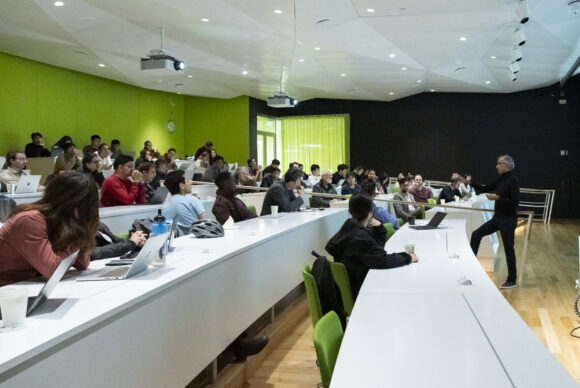
The 2026-27 season of the Kempner Seminar Series kicks off on October 16. The series brings leading scientists to Harvard to share their latest research in natural and artificial intelligence.
Cambridge, MA— The Kempner Institute for the Study of Natural and Artificial Intelligence at Harvard University today announced the speakers for the 2026-27 Kempner Seminar Series, a research-level seminar series highlighting recent advancements related to the basis of intelligence in natural and artificial systems.
Each talk, held in-person and open to the public, brings a leading intelligence researcher to Harvard to present their latest findings.
This year’s lineup brings together leading researchers from academia and industry whose work spans machine learning, language models, reinforcement learning, theoretical neuroscience, and cognitive science. Speakers will present emerging research in artificial intelligence, natural intelligence, and the connections between the two.
The series opens on Oct. 16 with a talk titled “The AI Scientific Revolution Will Be Driven by Open-Ended and AI-Generating Algorithms” by Jeff Clune, Professor of Computer Science at the University of British Columbia, co-founder of Recursive, and Canada CIFAR AI Chair and faculty member at the Vector Institute.
Talk titles and abstracts for the 2026-27 season will be posted on the Kempner Institute calendar as they are confirmed. Check back for updates.
Seminars are held in person, typically on Fridays, and are open to the public. Recordings of past talks are posted the week following each event.
2026-27 Kempner Seminar Series Speakers
- 10/16: Jeff Clune, Professor of Computer Science at the University of British Columbia; Co-founder, Recursive; Canada CIFAR AI Chair and Faculty Member at the Vector Institute
- 10/30: Diyi Yang, Assistant Professor of Computer Science at Stanford University
- 11/6: Surbhi Goel, Magerman Term Assistant Professor of Computer and Information Science at the University of Pennsylvania
- 11/12: Alexander Mathis, Associate Professor at the Brain Mind Institute, EPFL
- 1/22: Yair Weiss, Professor of Computer Science at Hebrew University
- 1/29: Danqi Chen, Associate Professor of Computer Science at Princeton University
- 2/5: Andrej Risteski, Associate Professor in the Machine Learning Department at Carnegie Mellon University
- 2/12: Mor Geva Pipek, Assistant Professor (Senior Lecturer) at the Blavatnik School of Computer Science and AI at Tel Aviv University
- 4/9: Adam Kalai, Chief Scientific Officer at the Institute for Responsible Superintelligence
- 4/16: Jason Lee, Associate Professor of EECS and Statistics at UC Berkeley and Senior Scientist at the Simons Institute for the Theory of Computing
- 4/23: Gautam Kamath, Assistant Professor of Computer Science at the Courant Institute of Mathematical Sciences at NYU
- 4/30: Qi Lei, Assistant Professor of Mathematics and Data Science at NYU
- 5/7: Kelsey Allen, Assistant Professor in the Departments of Computer Science and Psychology at the University of British Columbia
- 5/14: Peter Stone, Professor of Computer Science at The University of Texas at Austin
- 5/21: Dmitri Chklovskii, Group Leader, Neural Circuits and Algorithms, at the Flatiron Institute
About the Kempner Institute
The Kempner Institute seeks to understand the basis of intelligence in natural and artificial systems by recruiting and training future generations of researchers to study intelligence from biological, cognitive, engineering, and computational perspectives. Its bold premise is that the fields of natural and artificial intelligence are intimately interconnected: the next generation of AI will require the same principles that our brains use for fast, flexible natural reasoning, and understanding how our brains compute and reason can be elucidated by theories developed for AI. Join the Kempner mailing list to learn more and receive updates and news.