


Kempner Institute Celebrates Outgoing Research Fellows David Clark and Binxu Wang
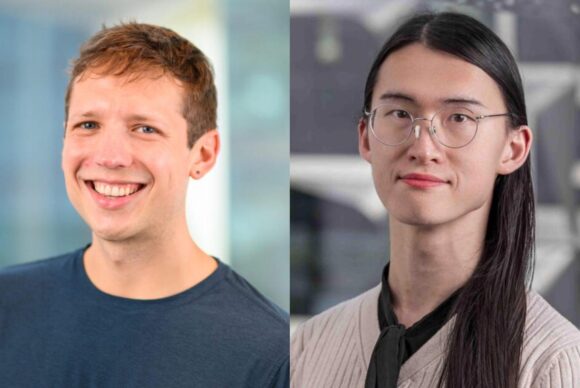
David Clark (left) and Binxu Wang (right), both neuroscientists, are completing their research fellowships at the Kempner this month.
Research Fellows David Clark and Binxu Wang will conclude their time at the Kempner Institute this month after making significant contributions to the Institute’s exploration of intelligence through research into the complexities of brain function.
Clark and Wang, who are both neuroscientists, will continue their research as they move into the next stages of their careers, taking on new roles leading their own research groups at renowned institutions: Clark at the Flatiron Institute’s Center for Computational Neuroscience — part of the Simons Foundation’s research division — and Wang at the Howard Hughes Medical Institute’s (HHMI) Janelia Research Campus.
David Clark: Decoding order from the chaos of neurons
Clark joined the Kempner as a research fellow in 2025. For the past year, he has focused on developing theories to explain how intricate, nonlinear neural networks operate and interact to program thought, motion, and action — tackling a pressing question in the field using methods from machine learning. Clark’s recent work, co-authored with Larry F. Abbott and Kempner Associate Faculty Haim Sompolinsky, is forthcoming and set to be published in Nature Neuroscience.
“A major breakthrough of theoretical physics over the last half century is the demonstration that high-dimensional nonlinear systems can [allow for] nice descriptions,” Clark says. “That’s promising, and an amazing fact in itself. The catch is that these systems from physics don’t do anything useful: they don’t walk across the room and have a conversation with you, prove theorems, and so on.”
“My research tries to extend such descriptions to systems like our brains that actually do things,” he says. “This is a big problem, and I’m extremely excited about it, particularly about how modern AI tools will shape and accelerate this process going forward.”
Clark will continue his work in theoretical neuroscience at the Flatiron Institute’s Center for Computational Neuroscience in Manhattan, New York as a Group Leader and Associate Research Scientist.
Binxu Wang: Harnessing AI to visualize the unsee
Wang, who was part of Kempner’s inaugural cohort of research fellows in 2023, studies the intersection of neuroscience and artificial intelligence — bringing the two disciplines into conversation with each other and encouraging the exchange of ideas between researchers on both sides.
Wang is particularly interested in generative models both as model organisms of creativity and as tools for studying the brain. She aims to understand how the brain can conjure a vivid perception of the world from the patterns of electrical activity. Her work explores this question from two sides — from understanding how generative models learn to create what they create, and also from building closed-loop systems that allow neurons to “talk” to generative models and create images that reveal what they prefer.
“The mathematics we use to predict how neurons respond to images is surprisingly similar to the mathematics behind how generative models create images,” Wang says, reflecting on her recent work on diffusion models, which received an Outstanding Paper Honorable Mention at this year’s ICML conference. “At their core, they share some of the same mathematical structures, so tools developed to understand one can often reveal something about the other — which is part of what makes it exciting to study brains and generative models side by side.”
As one of the Kempner’s first research fellows, Wang has witnessed the growth of the institute since its earliest years. Now, as she moves on to HHMI’s Janelia Research Campus in Ashburn, Virginia, Wang hopes to bring the interactive, hands-on approach to research she cultivated at the Kempner into her role as a Group Leader.
About the Kempner
The Kempner Institute seeks to understand the basis of intelligence in natural and artificial systems by recruiting and training future generations of researchers to study intelligence from biological, cognitive, engineering, and computational perspectives. Its bold premise is that the fields of natural and artificial intelligence are intimately interconnected; the next generation of artificial intelligence (AI) will require the same principles that our brains use for fast, flexible natural reasoning, and understanding how our brains compute and reason can be elucidated by theories developed for AI. Join the Kempner mailing list to learn more, and to receive updates and news.