

Kempner Institute Celebrates the Work of Research Fellows Wilka Carvalho, T. Anderson Keller, and Gabriel Poesia
The Kempner bids farewell to three research fellows as they move on to academic roles
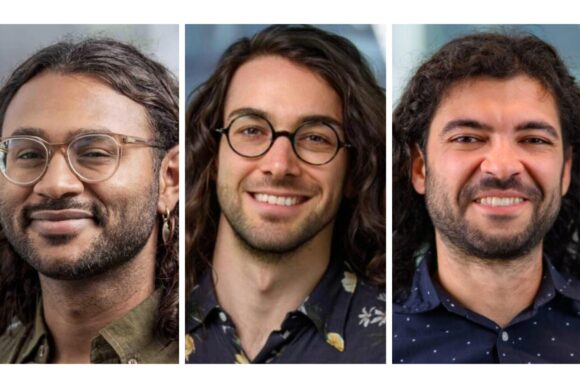
From left to right, Kempner Institute Research Fellows Wilka Carvalho, T. Anderson (Andy) Keller, and Gabriel Poesia. All three fellows conclude their fellowships this month and will move on to new roles at the forefront of intelligence research.
As Kempner Institute Research Fellows Wilka Carvalho, T. Anderson (Andy) Keller, and Gabriel Poesia conclude their fellowships this month, the Institute bids farewell to three scholars whose work has helped shape the growth of the Kempner and contributed to its research mission to advance the understanding of intelligence.
Each researcher will build upon their work at the Kempner their new roles in academia: Keller will join Cold Spring Harbor Laboratory, Poesia will begin a faculty position at the University of Michigan, and Carvalho will join Vanderbilt University in a faculty role.
Wilka Carvalho: Using AI to study human learning in realistic settings
Wilka Carvalho, who joined the Kempner in 2023, builds AI models that double as models of human learning. Carvalho’s research develops deep reinforcement learning (RL) models of cognition that, embedded into AI systems, both explain how people learn in complex, open-ended environments and improve AI performance in those environments.
At the Kempner, Carvalho worked with collaborators including Kempner associate faculty member Sam Gershman to advance naturalistic computational cognitive science, a research program whose AI models must also serve as theories of human learning in richer, more realistic settings. One outcome is Multitask Preplay, an AI model and cognitive theory of how the human mind adjudicates between fast, automatic behavior and slow, deliberate planning when generalizing to new tasks in large, open-ended environments. The model both predicts patterns of human generalization while also improving how artificial agents generalize to 1000s of novel 2D Minecraft-style worlds.
Carvalho will join Percepta as a Reinforcement Learning Research Scientist, where he will work alongside domain experts in critical sectors (healthcare, nonprofits, government) to build human-AI interaction technologies that support their work. In two years, he will join Vanderbilt University’s Computer Science Department as a Professor of Computational Psychology.
Andy Keller: Building structured representations of a changing world
Andy Keller, who also joined the Kempner in 2023 as a member of the inaugural cohort of research fellows, studies how abstract computational systems can form structured internal representations of a complex, changing world. At the Kempner, Keller expanded upon his structured representation framework, unveiling a new class of neural network models, called Flow Equivariant Recurrent Neural Networks (FERNNs), which can process video data containing moving or “flowing” objects.
Keller’s research is motivated by ideas from neuroscience, machine learning, and cognitive theory, including topographic organization, cortical traveling waves, equivariance, optimal transport, and intuitive physics.
In his next role, Keller will join Cold Spring Harbor Laboratory as a CSHL Simons Fellow in Neuroscience.
Gabriel Poesia: Developing AI systems for formal reasoning
Gabriel Poesia, who joined the Kempner Institute as a Research Fellow in 2025, develops self-improving software capable of formal reasoning, including systems that can prove mathematical theorems, make mathematical conjectures, decompose problems, and develop higher-level abstractions over time.
One of Poesia’s main projects at the Kempner explored open-ended generation of verified programs by merging ideas from mathematics with tools and constraints of program verification.
The work, undertaken in collaboration with Institute Investigator Yilun Du and associate faculty member Nada Amin, addresses a growing challenge in AI-assisted software development: language models can generate code far faster than humans can verify it. The research aims to develop stronger guarantees that code does what it is supposed to do, particularly in settings where bugs can carry real-world costs.
In September, Poesia will join the University of Michigan as an assistant professor in the Computer Science and Engineering (CSE) Division.
About the Kempner
The Kempner Institute seeks to understand the basis of intelligence in natural and artificial systems by recruiting and training future generations of researchers to study intelligence from biological, cognitive, engineering, and computational perspectives. Its bold premise is that the fields of natural and artificial intelligence are intimately interconnected; the next generation of artificial intelligence (AI) will require the same principles that our brains use for fast, flexible natural reasoning, and understanding how our brains compute and reason can be elucidated by theories developed for AI. Join the Kempner mailing list to learn more, and to receive updates and news.
PRESS CONTACT:
Deborah Apsel Lang | (617) 495-7993
kempnercommunications@harvard.edu