



What Your Walk Says About Your Movement Priorities
New study finds that a person’s walking data can help predict their movement priorities
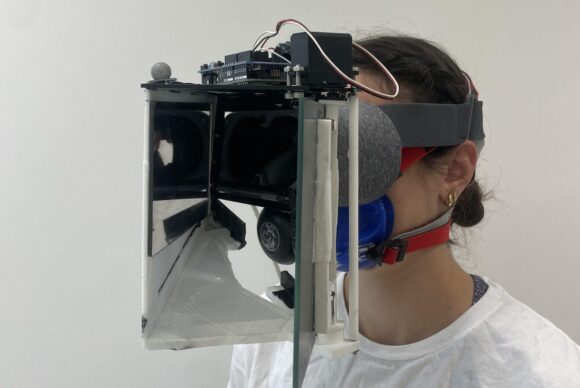
The "ViPer" or visual perturbation headset, developed by Kempner Institute associate faculty member Patrick Slade and his team, was used in a study examining how gait data can be used to predict movement priorities. By precisely manipulating each participant’s visual input during walking tasks, the headset allowed researchers to induce a controlled sense of imbalance. Image credit: Jordan Feldman
At a Glance
- Researchers led by Kempner Institute associate faculty member Patrick Slade developed a way to estimate a person’s movement priorities based on gait data, or measurements of a person’s walk.
- Using gait data collected from controlled walking tasks, the researchers trained a classical statistical model to predict a person’s relative prioritization of four movement goals — speed, stability, foot placement, and energy use — with high accuracy.
- The experimental methods used in the study included a hardware innovation called a “ViPer” (visual perturbation) headset, a device that safely alters a wearer’s visual field, enabling the researchers to cause controlled imbalances during walking. They could then analyze the impact of these perturbations on movement.
Devices that assist movement, including robotic exoskeletons — wearable frames that support and enhance motion — are becoming more common. To work well, these systems must respond to a user’s movement priorities, or the relative importance a person places on competing walking goals — such as speed, stability, foot placement, and energy use — at a given moment in time. If a device can’t detect whether someone is prioritizing speed versus maintaining balance from moment to moment, it might provide the wrong kind of support.
A new Harvard study shows that measurements of a person’s gait can be used to predict their movement priorities. Led by Kempner Institute associate faculty member Patrick Slade, an assistant professor of bioengineering at SEAS, the research team found that simple measures of a person’s gait can shed light on how they rank four key, competing movement priorities: speed, stability, foot placement, and energy use.
The study, published in the Journal of NeuroEngineering and Rehabilitation, establishes an approach for estimating movement priorities in young, healthy adults using simple gait metrics and provides a framework that could inform the development of future assistive technologies.
“With exoskeletons and similar devices, we typically pick a performance objective such as reducing energy use or increasing people’s walking speed,” explains Jordan N. Feldman, a PhD student in bioengineering at SEAS and first author of the study. “But we don’t actually know what the person cares most about at a given point in time, and we want to be able to assist them with what they do care most about. So, if we had a quantitative way to predict what they care about, we could assist them in that objective specifically.”
Deciphering human intentions from movement data
What a person cares about during movement is a combination of conscious goals and unconscious decisions made automatically in response to changing conditions. Slade and his team used a unique study design to gather movement data, and then built a statistical model that could predict both deliberate choices and automatic ones. In tests, the model’s error rate was as low as 11 percent.
“When we’re moving, we’re either planning and carefully deciding things — like step placement — or our bodies implicitly make decisions,” said Slade.
To measure different “dimensions” of movement — distinct measurements picked up by wearable sensors — the researchers asked 12 participants to complete walking tasks modeled on everyday situations such as rushing for a bus or walking under conditions that challenged their balance. To create these varied conditions, the researchers developed a device called the visual perturbation, or “ViPer,” headset. It subtly shifts a person’s visual field as they walk, creating a controlled sense of imbalance in a safe, natural setting, as opposed to within a virtual environment, where such studies are typically conducted.
Each task emphasized one of four priorities: speed, stability, foot placement, or energy use. Because participants could not prioritize all four at once, they had to make trade-offs. The researchers carefully controlled the demands of each task, including aspects of the participants’ perception using the ViPer. This control enabled them to better analyze how participants adjusted their movement priorities in response to task demands.
As participants performed each task, the researchers recorded a range of gait measurements using wearable sensors. These sensors captured many dimensions of muscle activity and breathing. Together, these dimensions created a detailed, high-dimensional picture of each person’s movement patterns.
The team then used this detailed dataset to train a simple statistical model to predict participants’ priorities in each task. The model successfully used gait data to estimate how each person ranked the four movement goals.
Toward more responsive assistive technologies
According to Slade and Feldman, the study’s findings suggest that in the future, assistive systems could adapt in real time by deciphering a user’s priorities from wearable sensor data. An exoskeleton, for example, might provide more support for balance when a user focuses on stability, or boost speed when they try to move faster.
“You’re helping them walk faster, or in an older adult case, maintain balance when they clearly seem unstable,” explains Slade.
In addition to suggesting a way to enhance assistive systems, the study’s approach could help with movement therapy and rehabilitation. According to Slade, clinicians could use the approach to assess how patients approach movement — whether they emphasize safety, speed, or energy efficiency — and adjust their therapeutic methods accordingly.
Next, the researchers plan to incorporate additional data, including brain signals they have already begun recording, to build a more detailed system for prediction of movement goals.
“We’re going to take all of these signals that we collected and try to build a more comprehensive model,” said Slade, who says that incorporating these additional sources of data could potentially enable more accurate predictions of movement priorities.
Beyond enhancing predictive power, Slade sees an opportunity for a more comprehensive model to shed light on how humans decide among competing movement priorities: a key aspect of human intelligence. “We could potentially use this sort of idea for a human level model to understand the neuroscience behind decision-making for human movement.”