


Five Kempner Undergraduates Among Winners of 2026 Hoopes Prize
Awarded annually to Harvard College undergraduates, the prize recognizes outstanding scholarly work or research
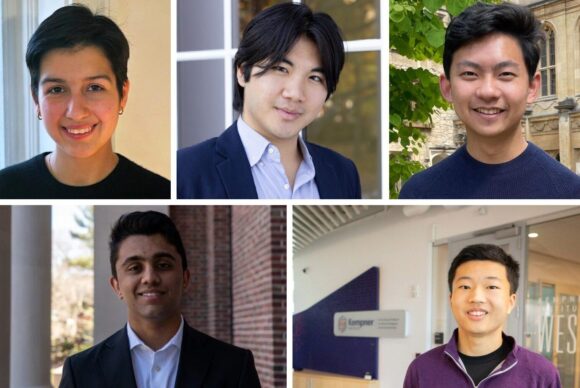
Five Kempner-affiliated undergraduates were among the 2026 winners of the Hoopes Prize. Clockwise from top left: Emma Finn, Sean Meng, Johnathan Sun, Benjamin Choi, and Neil Shah.
Five Kempner Institute student researchers were among the awardees of the 2026 Thomas Temple Hoopes Prize, which recognizes outstanding scholarly work or research conducted by undergraduates at Harvard College. The winning Kempner-affiliated students, all graduating seniors at Harvard who participated in the Kempner’s undergraduate student research programs, are Emma Finn, Benjamin Choi, Sean Meng, Neil Shah and Johnathan Sun.
The Hoopes Prize, established through a gift of Thomas T. Hoopes, Class of 1919, is awarded annually for research or scholarly projects undertaken by Harvard College undergraduates. Student projects must be nominated for consideration by the project’s advisor, and are selected by a committee of faculty from Harvard’s Faculty of Arts and Sciences.
The five Kempner-affiliated awardees were participants in Kempner undergraduate research programs, which include the KURE and KRANIUM programs, which provide Harvard undergraduates with funding, mentorship, and research opportunities focused on the study of intelligence.
Student winners of the Hoopes Prize receive \$5,000 to support future studies and faculty nominators of winning projects receive \$2,000. In addition, copies of winning projects are placed in the University Archives and written projects are made available in Lamont Library for at least two years.
About the Winning Projects
Benjamin Choi’s project, “Latent Structure of Affective Representations in Large
Language Models,” supervised by Kempner affiliate faculty Melanie Weber, Assistant Professor of Applied Mathematics and of Computer Science at SEAS, explores how large language models represent emotion. By comparing language models with human brain data, he uncovered what he describes as “shared structural principles between artificial and biological systems.”
Emma Finn’s project, “Quantifying the Past: Empirical Tropes in Greek
Historiography,” supervised by Emily Greenwood, James F. Rothenberg Professor of the Classics and of Comparative Literature, traces the ethical implications of quantification in the writings of ancient Greek historians, investigating the intertwined histories of how we speak, how we measure quantities, and how we assign ethical value. During her time at the Kempner, Finn was mentored by associate faculty member Demba Ba, who, she says, encouraged her to reflect on how her technical work and philosophical work could support one another.
Sean Meng’s project, “Rewired by Time: A Dopaminergic Account of
Cognitive Flexibility Across the Mouse Lifespan,” supervised by Kempner Institute Co-Director Bernardo Sabatini, Alice and Rodman W. Moorhead III Professor of Neurobiology at Harvard Medical School, explores how the brain’s dopamine systems, which are central to reward-driven learning and other neural processes, shape cognitive flexibility in mice.
Neil Shah’s project, “Hardness of Sampling for Random Constraint Satisfaction
Problems,” supervised by Mark Sellke, Assistant Professor of Statistics, proves that a broad class of computational algorithms fails once enough constraints are added to lock in many variable choices. At the Kempner, Shah was mentored by Research Fellow Wilka Carvalho.
Johnathan Sun’s project, “The User in the Prompt: A Theory of Context-Sensitive
Choice in Language Models,” developed a theory of how language models interpret and respond to user context. His project was supervised by Yonatan Belinkov, a Kempner Institute visiting scholar and Assistant Professor of Computer Science at Technion – Israel Institute of Technology.
About the Kempner Institute
The Kempner Institute seeks to understand the basis of intelligence in natural and artificial systems by recruiting and training future generations of researchers to study intelligence from biological, cognitive, engineering, and computational perspectives. Its bold premise is that the fields of natural and artificial intelligence are intimately interconnected; the next generation of artificial intelligence (AI) will require the same principles that our brains use for fast, flexible natural reasoning, and understanding how our brains compute and reason can be elucidated by theories developed for AI. Join the Kempner mailing list to learn more, and to receive updates and news.