


Announcing 2026 Kempner Institute Research Fellows
Six innovative early-career scientists awarded fellowships to undertake research that advances the understanding of intelligence
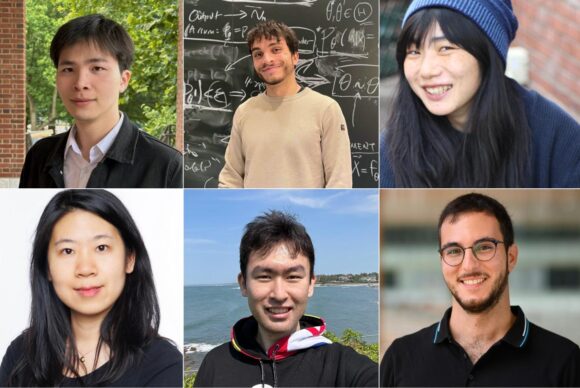
The 2026 recipients of the Kempner Institute Research Fellowships are, clockwise from upper left, Jieneng Chen, Marco Fumero, Audrey Huang, Raja Marjieh, Yinuo Ren and Anne Wu.
Cambridge, MA – The Kempner Institute for the Study of Natural and Artificial Intelligence at Harvard is pleased to announce the recipients of its 2026 Kempner Institute Research Fellowships. The 2026 recipients are Jieneng Chen, Marco Fumero, Audrey Huang, Raja Marjieh, Yinuo Ren and Anne Wu.
The six fellowship recipients are all early-career scientists representing a broad range of skillsets and educational backgrounds. Each of them is working to answer pressing research questions at the intersection of natural and artificial intelligence.
Each fellow will serve for a term of up to three years and will receive salary and research funds, office space, and mentorship. Fellows set their own research agenda, but they are strongly encouraged to work between disciplines and to collaborate with experts at the Kempner Institute and throughout Harvard University.
About the fellows
Jieneng Chen builds foundation models for general visual intelligence. His work turns raw visual input into structured, geometry-aware representations that support reasoning, imagination, and action in 3D/4D environments. Spanning vision, multimodal learning, embodied AI, and biomedical science, he aims to give machines an intuitive and predictive understanding of the physical world for real-world impact.
Marco Fumero’s research lies at the intersection of representation learning, geometry, and causal learning. It seeks to understand when and why machine learning models trained with different architectures, objectives, and modalities learn similar representations, and what this convergence reveals about the mechanisms underlying learning and generalization. By analyzing the geometry of learned representations and their relationship to causal factors and data invariances, Fumero develops methods for comparing and aligning representations across models, enabling efficient transfer and reuse of information across pretrained systems.
Audrey Huang’s research focuses on developing the scientific and mathematical foundations of interactive decision making in modern-day settings, such as post-training in language models. Looking forward, she is especially interested in investigating the role of reinforcement learning in contemporary LLM training pipelines, as well as in understanding the optimization dynamics of reinforcement learning.
Raja Marjieh investigates the computational principles underlying effective cognitive representations. His work combines advances in artificial intelligence, large-scale behavioral studies, and new paradigms known as “algorithms with people” to explore research directions that were previously infeasible, such as the precise mapping between perception and language, the relationship between representation and generalization in naturalistic domains, and the interaction of representation and collective behavior in human-AI populations.
Yinuo Ren develops mathematically grounded and computationally efficient generative modeling methods at the intersection of stochastic processes, numerical analysis, and modern machine learning. His research aims to connect model design to representation power, training dynamics, and error behavior, enabling generative models that are interpretable and controllable, instead of purely data-driven black boxes. His ultimate goal is to transform generative models into domain-aware priors that support scalable inference and discovery across the natural and engineering sciences.
Anne Wu‘s research focuses on developing models that learn from natural signals in complex interactive environments. Her work centers on achieving robust, grounded understanding and communication in interactive settings, particularly within multimodal conversational models. Her goal is to build AI models that are natively interactive, capable of developing a grounded, adaptive understanding of the world through multimodal interaction with humans and environments.
About the Kempner
The Kempner Institute seeks to understand the basis of intelligence in natural and artificial systems by recruiting and training future generations of researchers to study intelligence from biological, cognitive, engineering, and computational perspectives. Its bold premise is that the fields of natural and artificial intelligence are intimately interconnected; the next generation of artificial intelligence (AI) will require the same principles that our brains use for fast, flexible natural reasoning, and understanding how our brains compute and reason can be elucidated by theories developed for AI. Join the Kempner mailing list to learn more, and to receive updates and news.
PRESS CONTACT: Deborah Apsel Lang | deborah_apsel_lang[at]harvard.edu.